Stuart Varney Bio: Married, Age, Parents, Career, Net Worth & Personal Life
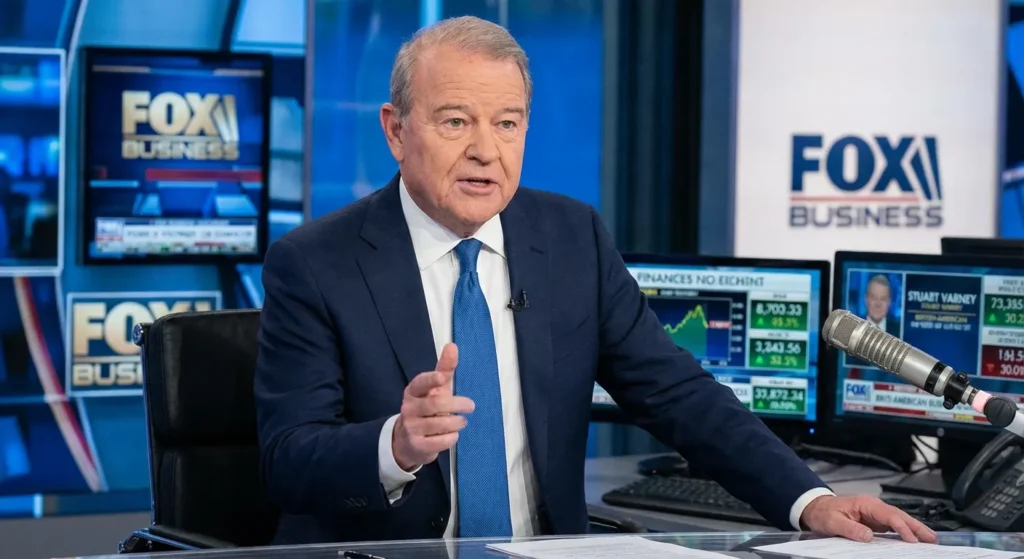
Stuart Varney has become one of the most influential voices in American business journalism, building a career that spans four decades across multiple continents and major news networks. As host of Fox Business Network’s highest-rated market program “Varney & Co.,” he delivers daily economic analysis and political commentary to millions of viewers during the crucial morning trading hours. His distinctive British accent, combined with his conservative economic perspective and deep market expertise, has made him a recognizable figure in financial media and a trusted voice for investors seeking clarity in complex economic environments.
In 2025, Stuart Varney’s net worth stands at $14 million, accumulated through his successful broadcasting career, strategic real estate investments, and entrepreneurial ventures including a profitable timber business. His annual Fox Business salary of $4 million reflects his value as the network’s premier morning anchor and his ability to consistently deliver top ratings in competitive business news programming. However, Varney’s personal life has been marked by significant controversy, including a highly publicized 2014 divorce from his wife Deborah following revelations of a nine-year extramarital affair, which brought unwanted scrutiny to his private conduct despite his professional success.
This comprehensive profile examines Stuart Varney’s journey from Derby, England to American media prominence, his salary evolution and wealth accumulation strategies, his tumultuous personal life including his divorce and six children, his extensive real estate holdings, and the professional achievements that have sustained his career through changing media landscapes and personal challenges.
Stuart Varney Personal Information
| Category | Details |
|---|---|
| Full Name | Stuart Varney |
| Date of Birth | July 7, 1948 |
| Age | 76 years (as of 2025) |
| Birthplace | Derby, Derbyshire, England, United Kingdom |
| Nationality | British-American (became U.S. citizen in 2015) |
| Ethnicity | British/English |
| Profession | Economic Journalist, Television Host, Business Commentator |
| Current Position | Host of “Varney & Co.” (Fox Business Network) |
| Annual Salary | $4 Million |
| Net Worth (2025) | $14 Million |
| Former Spouse | Deborah Varney (married 1993-2014) |
| Years Married | 21 years |
| Divorce Year | 2014 |
| Divorce Reason | Infidelity with Jennifer F. Shibley (9-year affair) |
| Children | 6 (four boys, two girls) |
| Grandchildren | 10 |
| Notable Children | Angela Varney (Fox Nation Associate Producer), Jull Varner Meyer |
| Current Relationship | Jennifer Shibley (Florida woman, relationship began 2005) |
| Education | London School of Economics (Graduate) |
| Pre-College | Secondary school in England, one year working in Nairobi, Kenya |
| U.S. Arrival | 1974 |
| U.S. Citizenship | Late 2015 |
| Career Start | Radio Hong Kong |
| CNN Joining | 1980 (Manhattan bureau) |
| Fox News Joining | January 2004 |
| Fox Business Joining | 2007 (network launch year) |
| Current Show | Varney & Co. (weekdays 9 AM-12 PM ET) |
| Other Show | American Built (FBN Prime) |
| Awards | Peabody Award (CNN team, 1987 stock market crash coverage) |
| Primary Residence | Franklin Lakes, New Jersey ($670,000 purchase, 1995) |
| Secondary Residence | Hoboken, New Jersey (condo near Manhattan) |
| Farm Property | 1,100-acre farm in Deposit, New York (purchased 2002) |
| Farm Features | 250,000 trees, timber harvesting business (1,000 trees annually) |
| Political Alignment | Conservative, ally of conservative American politics |
What Is Stuart Varney’s Net Worth in 2025?
Stuart Varney has accumulated a net worth of $14 million as of 2025, positioning him as one of the financially successful personalities in business journalism, though not reaching the highest echelons occupied by some cable news superstars. His wealth reflects nearly five decades of consistent earnings in broadcast journalism, beginning with his 1974 arrival in the United States and progressing through increasingly prominent positions at Radio Hong Kong, KEMO-TV, CNN, CNBC, Fox News, and Fox Business Network.
Varney’s $14 million net worth stems from multiple revenue streams developed throughout his career. His primary income source is his $4 million annual salary from Fox Business Network, where he has worked since 2007. This substantial compensation reflects his role hosting the network’s highest-rated market program during the strategic 9 AM to 12 PM Eastern time slot when pre-market trading activity intensifies and investors make critical decisions based on overnight market movements and morning economic data releases.
Beyond his Fox Business salary, Varney has diversified his wealth through strategic real estate investments and entrepreneurial ventures. His property portfolio includes a home in Franklin Lakes, New Jersey purchased in 1995 for $670,000, a condominium in Hoboken positioned conveniently across the Hudson River from Manhattan for easy commuting, and most notably, an expansive 1,100-acre farm in Deposit, New York acquired in 2002 that serves both as a personal retreat and a profitable timber business.
The Deposit farm property features approximately 250,000 trees including red oak, maple, and black cherry varieties. Varney operates an active timber harvesting operation, cutting around 1,000 trees annually for furniture production, creating a supplementary income stream beyond his broadcasting salary. Speaking to the New York Forest Owners Association, Varney explained his attraction to the property: “It reminds me very much of rural England: rolling hills, deciduous forest, four very distinct seasons.” He also noted that in his native England, owning a 1,000-plus acre estate would require billionaire wealth, making the American property market’s accessibility particularly appealing.
Additional income sources contributing to Varney’s net worth include brand endorsements, sponsorship deals, speaking engagement fees at corporate events and financial conferences, and potential investment portfolios built over decades of financial market expertise. His position as a prominent business journalist provides unique insights into market opportunities that, if applied to personal investing with appropriate ethical boundaries, could enhance wealth accumulation beyond salary alone.
Stuart Varney Annual Salary at Fox Business Network
Stuart Varney earns an annual salary of $4 million at Fox Business Network, placing him among the higher-compensated business journalists in cable news though below the absolute top tier occupied by personalities like Maria Bartiromo. This substantial compensation reflects multiple factors including his role as sole host of the network’s flagship morning program, his consistent delivery of top ratings in the competitive business news landscape, his nearly 18-year tenure with Fox Business since the network’s 2007 launch, and his additional contributions across Fox News Channel programming.
Varney’s $4 million salary represents recognition of his value in capturing the crucial morning audience when investors, financial professionals, and business decision-makers consume news and analysis before market opening. The 9 AM to 12 PM time slot commands premium advertising rates due to its strategic importance for financial services companies, investment firms, and business-to-business advertisers seeking to reach high-income, decision-making audiences.
His compensation package likely extends beyond base salary to include performance bonuses tied to ratings achievements, overtime pay for special coverage during major economic events or market crises, comprehensive health insurance benefits for himself and family members, retirement account contributions with employer matching, professional development funding, and potentially stock options in Fox Corporation. These additional benefits could add 20-30% to his stated salary in total compensation value.
The consistency of Varney’s employment at Fox Business since 2007, without major contract disputes or public negotiations, suggests favorable terms that have satisfied both network management and Varney himself. Television journalism contracts typically run two to three years with renewal options, meaning Varney has successfully negotiated at least six contract renewals throughout his Fox Business tenure, each likely including salary escalations reflecting inflation, market competitiveness, and his growing audience loyalty.
Compared to his Fox Business colleagues, Varney’s $4 million salary equals Charles Payne’s compensation and exceeds many other network personalities, though it falls below Maria Bartiromo’s estimated $10 million annual earnings and Neil Cavuto’s $7 million salary. This compensation hierarchy reflects program prominence, individual bargaining leverage, and market value assessments that networks make when allocating talent budgets across their programming schedules.
Stuart Varney Early Life and Education
Stuart Varney was born on July 7, 1948, in Derby, Derbyshire, England, during the post-World War II period when Britain was rebuilding its economy and society. Growing up in Derby, an industrial city in the East Midlands known for manufacturing and engineering, Varney experienced the economic challenges and social transformations of mid-20th century Britain, experiences that likely influenced his later economic and political perspectives.
Following his secondary school education in England, Varney made an unconventional decision for a young Briton: spending a year working in Nairobi, Kenya. This African experience provided early international exposure and demonstrated adventurous spirit and willingness to pursue opportunities beyond comfortable British boundaries. The skills and perspective gained from this year abroad foreshadowed his later international career trajectory spanning multiple continents.
Varney went on to attend the London School of Economics, one of the world’s premier institutions for economics, political science, and social sciences. LSE’s rigorous academic environment and its tradition of producing influential economists, politicians, and business leaders provided Varney with sophisticated understanding of economic theory, market dynamics, and policy analysis that would form the intellectual foundation for his journalism career. His LSE education distinguished him from many television journalists who lack formal economics training, giving him credibility when analyzing complex financial topics.
After graduating from LSE, Varney began his broadcast journalism career rather than pursuing traditional economics paths in academia, government service, or financial institutions. This decision to apply his economics education through media communication rather than technical analysis or policy development proved strategically sound, as his ability to translate complex economic concepts for general audiences became his defining professional strength.
In 1974, at age 26, Varney made the life-changing decision to relocate to the United States, arriving during a period of significant American economic challenges including stagflation, energy crises, and political turmoil following Watergate. Despite these difficulties, America offered media opportunities and professional advancement potential that attracted ambitious young journalists. Varney would spend the next 41 years as a British citizen working in American media before finally becoming a naturalized U.S. citizen in late 2015, demonstrating his ultimate commitment to his adopted country.
Stuart Varney Career Journey: From Radio Hong Kong to Fox Business
Stuart Varney’s broadcast journalism career began at Radio Hong Kong, where he gained foundational experience in news reporting, audio production, and deadline-driven journalism. This early position in one of Asia’s major financial centers provided exposure to international business news and economic reporting that would define his later career specialization.
From Hong Kong, Varney relocated to San Francisco, where he worked at KEMO-TV, a local television station that provided his first American broadcasting experience and his transition from radio to television journalism. Working at a local station required versatility, as journalists typically covered diverse topics rather than specializing in business news. This broad experience built fundamental television skills including on-camera presence, script writing, and visual storytelling.
In 1980, Varney received the career-defining opportunity that would launch him to national prominence: recruitment to join CNN’s Manhattan bureau as the cable news channel worked to establish itself as a legitimate news source challenging the broadcast networks. CNN, founded earlier that year, was building its business news team, and Varney became a foundational member of this effort. His economics education from LSE and his international experience made him an ideal candidate for CNN’s ambitious business coverage plans.
At CNN throughout the 1980s and 1990s, Varney hosted multiple financial programs including “Your Money,” “Business Day,” and “Business Asia,” establishing himself as a trusted voice in business journalism during a transformative period for global economics. He co-hosted “Moneyline News Hour” with Willow Bay, CNN’s flagship business program that competed with similar offerings on broadcast networks and established CNN’s credibility in financial reporting.
Varney’s most significant professional achievement at CNN came through his reporting and analysis of the October 1987 stock market crash, when the Dow Jones Industrial Average plummeted 22.6% in a single day—the largest one-day percentage decline in stock market history. His clear, authoritative coverage during this crisis helped earn CNN a Peabody Award for excellence in journalism, recognizing the team’s ability to inform viewers during unprecedented market chaos. This crisis reporting experience built Varney’s reputation for maintaining composure and providing valuable analysis during market volatility.
After departing CNN in 2001, Varney moved to CNBC, CNN’s primary competitor in business news broadcasting. At CNBC, he hosted “Wall Street Journal Editorial Board with Stuart Varney,” a program that combined business reporting with editorial perspective, allowing Varney to express viewpoints more directly than traditional objective reporting formats permitted. This CNBC tenure proved relatively brief compared to his CNN and later Fox tenures, serving as a transitional period between major career chapters.
In January 2004, Varney joined Fox News’s business team, marking his entry into the News Corporation (later 21st Century Fox, now Fox Corporation) media ecosystem. This move aligned with Fox’s growing emphasis on business coverage and its plans to eventually launch a dedicated business channel to compete with CNBC. For three years, Varney contributed business reporting and analysis across Fox News programming, building relationships with network management and demonstrating his value to the organization.
When Fox Business Network launched in October 2007 as a direct competitor to CNBC, Varney became one of the network’s founding anchors, joining contemporaries including Neil Cavuto, Alexis Glick, and David Asman in the initial programming lineup. His CNN pedigree and established business journalism reputation provided immediate credibility to the new network’s efforts to attract audiences from the dominant CNBC.
In 2010, Varney began hosting “Varney & Co.,” which would become Fox Business Network’s signature morning program and the network’s highest-rated show. The program airs weekdays from 9 AM to 12 PM Eastern Time, providing three hours of market coverage, political analysis, and interviews with business leaders, politicians, and cultural figures. The show’s format blends serious market analysis with conservative political commentary, appealing to Fox Business’s target demographic of business professionals and politically conservative viewers interested in market news.
“Varney & Co.” features regular contributors including Ashley Webster who serves as guest host, correspondent, and contributor, along with anchors Susan Li and Lauren Simonetti who provide market updates and segment reporting. The show has welcomed numerous high-profile guests over the years, with the most frequent including journalist Nicole Petallides and conservative political commentator Kayleigh McEnany, former White House press secretary under President Trump. Notable guest appearances have included automotive designer Henrik Fisker, business reporter Sandra Smith, Olympic soccer champion Abby Wambach, and numerous political figures and business titans.
Beyond “Varney & Co.,” Varney hosts “American Built” on FBN Prime, a series showcasing the engineering and ingenuity behind iconic American landmarks and infrastructure projects. This program allows Varney to explore American innovation and industrial achievement, themes that resonate with his conservative political perspective and appreciation for entrepreneurial success.
Varney also serves as a regular panel member on Fox Business’s “Cashin’ In” and makes frequent appearances on Fox News Channel’s “Your World with Neil Cavuto,” occasionally serving as guest host. These cross-platform appearances maximize his visibility across Fox Corporation’s business and news programming, enhancing his overall value to the company.
Most recently, Varney contributed to Fox Business Network’s 2022 Midterm Election panel alongside Maria Bartiromo, Charles Payne, and Larry Kudlow, demonstrating the network’s confidence in his ability to provide political analysis extending beyond pure business coverage. His evolution from pure business journalism to political-economic commentary reflects both his personal ideological alignment with conservative politics and Fox Business’s programming strategy of blending market coverage with political perspective.
Stuart Varney Marriage to Deborah and Divorce Controversy
Stuart Varney began dating a woman named Deborah in 1992, reportedly meeting her at a pub in what seemed like a chance romantic encounter. After a year of courtship, the couple married in 1993 in a small ceremony, beginning what would become a 21-year marriage that produced six children—four boys and two girls—and established the family foundation that Varney would later betray through prolonged infidelity.
Throughout their marriage, Deborah served as the primary caregiver for their large family while Varney pursued his increasingly prominent broadcasting career. The couple’s life appeared outwardly successful, with Varney’s rising professional profile providing financial security and public respectability. They raised their children in New Jersey, maintaining a family home in Franklin Lakes purchased in 1995 that provided suburban stability outside the intense Manhattan media environment where Varney worked.
However, beneath this conventional family exterior, Varney was conducting a secret nine-year extramarital affair with Jennifer F. Shibley, a woman from Florida. The affair, which reportedly began around 2005, continued through nearly half of Varney’s marriage to Deborah, demonstrating sustained deception that extended far beyond a brief lapse in judgment. Varney allegedly took Shibley on international trips to Hawaii, Hong Kong, Singapore, and Macau, spending what Deborah’s divorce complaint later described as “hundreds of thousands of dollars” on his mistress while maintaining his marriage and family obligations.
In 2014, the affair’s exposure led Deborah to file for divorce in Bergen County, New Jersey, ending their 21-year marriage. The divorce complaint, which became public record and provided extensive details about Varney’s infidelity, painted a devastating picture of betrayal and financial impropriety. According to the complaint, when Deborah confronted Varney about the affair, he allegedly responded: “When I was with you, I did not think about her, and when I was with her, I did not think about you,” suggesting compartmentalization that allowed him to maintain separate emotional lives.
Even more troubling, the complaint alleged that Varney insisted he “was not in love” with Shibley but cheated because he “could do it,” framing his infidelity as an exercise of power and opportunity rather than emotional connection. This characterization, if accurate, suggested moral failings extending beyond marital betrayal to fundamental character issues regarding entitlement and abuse of privilege.
Deborah’s divorce complaint accused Varney of “living a double life” and squandering substantial family resources on his extramarital relationship. The reference to “hundreds of thousands of dollars” spent on Shibley raised questions about financial accountability within the marriage and whether Varney had prioritized his affair over his family’s financial interests. For a business journalist who regularly lectured viewers about financial responsibility and prudent money management, such alleged personal financial recklessness carried particular irony.
The divorce proceedings attracted media attention due to Varney’s public profile and the sensational nature of the allegations. While some media personalities have weathered similar scandals through public contrition and image rehabilitation, Varney largely avoided public discussion of the divorce, neither confirming nor denying specific allegations while allowing the legal process to proceed privately despite the public filing.
The divorce settlement terms have not been publicly disclosed, though given Varney’s substantial income and the length of the marriage, Deborah likely received significant financial compensation including property division, spousal support, and potentially child support for minor children still dependent at the time of divorce. The financial impact on Varney’s net worth was likely substantial, potentially explaining why his current $14 million net worth, while impressive, remains below levels that might be expected given his four-decade high-earning career.
Following the divorce, Varney apparently continued his relationship with Jennifer Shibley, suggesting the affair represented more than casual infidelity and possibly indicating genuine attachment despite his alleged claims during the divorce that he was “not in love” with her. However, details about his current relationship status remain largely private, as Varney has maintained discretion about his personal life following the divorce publicity.
Stuart Varney Six Children and Family Relationships
Stuart Varney and Deborah Varney had six children together during their 21-year marriage: four boys and two girls whose names and specific details remain largely private, as the family has protected the children from excessive media attention despite their father’s public profile. The children’s ages in 2025 would range from young adults to potentially early middle age, depending on when during the marriage they were born.
Among the Varney children, daughter Angela Varney has followed her father into the broadcast journalism industry, working as an associate producer on Fox Nation, Fox News Channel’s subscription streaming service. Angela’s career choice demonstrates the influence of growing up with a prominent broadcast journalist father and suggests she inherited interest in media production and conservative political content that characterizes Fox Nation’s programming. Her position at Fox Nation also indicates possible family connections facilitating her entry into the competitive television industry, though her success ultimately depends on her own professional capabilities.
Another daughter, Jull Varner Meyer, has children of her own, making Stuart Varney a grandfather. Overall, Varney has ten grandchildren across his six children, representing the next generation of his family legacy. The grandchildren’s existence suggests that despite the turbulent divorce and family disruption caused by his infidelity, Varney maintains some ongoing family relationships and has transitioned into a grandfather role.
The impact of Varney’s divorce and the public nature of his infidelity allegations on his relationships with his children has not been publicly discussed. Adult children often struggle when parents divorce, particularly when infidelity is involved, and the nine-year duration of Varney’s alleged affair means his children may have been adolescents or young adults during significant portions of the deception. Whether the children have maintained close relationships with their father or whether the divorce created lasting family divisions remains unknown.
Varney’s children would have witnessed the contrast between their father’s public persona as a trusted financial commentator and moral voice on economic policy, and the private reality of his prolonged extramarital affair and alleged financial impropriety. This disconnect between public image and private behavior often creates particular challenges for children of public figures, who must reconcile their personal knowledge with their parent’s professional reputation.
The family dynamics become even more complex considering Varney’s apparent ongoing relationship with Jennifer Shibley following the divorce. If Varney’s children have had to integrate Shibley into family gatherings or accept her presence in their father’s life, this would represent additional emotional complexity beyond the typical challenges of parental divorce.
Despite these family challenges, Varney has continued his successful broadcasting career without apparent impact on his professional standing at Fox Business. Unlike some media personalities whose personal scandals have ended their careers, Varney maintained his hosting position and ratings throughout and following the divorce, suggesting either that his audience did not care about his personal conduct, or that Fox Business Network determined his professional value outweighed any reputation damage from the scandal.
Stuart Varney Real Estate Portfolio and Investments
Stuart Varney has built a substantial real estate portfolio that contributes significantly to his $14 million net worth while also reflecting his personal values and lifestyle preferences. His property holdings demonstrate strategic investment in both practical residential real estate for work convenience and aspirational rural property satisfying his emotional connection to the English countryside of his youth.
Varney’s primary residence during the work week is located in Franklin Lakes, New Jersey, a prosperous suburban community in Bergen County known for large homes, excellent schools, and affluent residents. He purchased this property in 1995 for $670,000, a significant investment at the time that has likely appreciated substantially over the past 30 years. Franklin Lakes offers the perfect combination of proximity to Manhattan—approximately 25 miles northwest of the city—and suburban privacy away from the intense urban environment where Varney works.
The Franklin Lakes property provided family stability during his marriage to Deborah, offering space for raising six children in a community with strong schools and family-friendly amenities. The suburb’s distance from Manhattan also created physical separation between Varney’s professional life and his family life, a boundary that may have facilitated his ability to conduct his extramarital affair without immediate family scrutiny.
In addition to the Franklin Lakes home, Varney owns a condominium in Hoboken, New Jersey, positioned directly across the Hudson River from Manhattan with easy access to Fox Business Network’s studios. This secondary residence likely serves as a weekday crash pad during intense news cycles requiring early morning and late evening work hours, eliminating long commutes from Franklin Lakes during demanding workweeks. Hoboken’s waterfront location and urban amenities also provide lifestyle benefits including dining, entertainment, and cultural attractions more readily available than in suburban Franklin Lakes.
The jewel of Varney’s real estate portfolio is his 1,100-acre farm in Deposit, New York, purchased in 2002 for an undisclosed price. This expansive property represents both a personal retreat and a profitable business venture, demonstrating Varney’s ability to combine lifestyle preferences with investment strategy. The former dairy and beef farm features approximately 250,000 trees including red oak, maple, and black cherry varieties, creating a substantial timber resource that Varney actively manages.
Varney operates a sustainable timber harvesting business on the property, selectively cutting around 1,000 trees annually for furniture production. This generates ongoing revenue while maintaining the forest’s long-term health and value. Speaking to the New York Forest Owners Association, Varney explained his attraction to the property: “It reminds me very much of rural England: rolling hills, deciduous forest, four very distinct seasons.” The property’s resemblance to the English countryside provides emotional connection to his roots while representing an investment opportunity that would be financially impossible in England, where he noted one would need to be a billionaire to afford a 1,000-plus acre estate.
The Deposit farm also serves as a personal sanctuary where Varney can escape Manhattan’s intensity and reconnect with nature. For someone who built his career analyzing markets and navigating competitive media environments, the farm represents a completely different world focused on natural cycles, forest management, and rural traditions. This dual life—weekday media personality and weekend gentleman farmer—reflects complexity in Varney’s character beyond his public broadcasting persona.
The financial value of Varney’s real estate portfolio likely constitutes a substantial portion of his $14 million net worth. The Franklin Lakes property, purchased for $670,000 in 1995, has probably appreciated to well over $1 million given Bergen County’s strong real estate market. The Hoboken condominium, depending on size and exact location, could be worth $500,000 to over $1 million in Hoboken’s competitive real estate market. The 1,100-acre Deposit farm, with its timber resources and development potential, could be worth several million dollars, particularly to buyers seeking large rural estates within driving distance of New York City.
Beyond these known properties, Varney may hold additional real estate investments not publicly disclosed, as wealthy individuals often diversify holdings across multiple properties and investment vehicles. His four decades of high earnings provided ample opportunity to accumulate investment real estate beyond personal residences.
Stuart Varney Political Views and Controversial Remarks
Stuart Varney has established himself as a prominent voice in conservative political and economic commentary, using his Fox Business platform to advocate for free-market principles, limited government, low taxation, and traditional conservative policy positions. While he frames his commentary as economic analysis, his views clearly align with Republican Party orthodoxy and conservative political philosophy, making him a valuable asset to Fox Corporation’s conservative media ecosystem.
Varney’s political evolution from British citizen to conservative American commentator represents an interesting ideological journey. While his economic education at the London School of Economics exposed him to various economic theories, his adopted American political identity embraces free-market capitalism with an enthusiasm that sometimes exceeds native-born American conservatives. His 41-year wait before seeking U.S. citizenship, finally naturalizing in late 2015, suggests initial reluctance to fully commit to American identity, though his professional success and political alignment ultimately led him to formalize his citizenship status.
His conservative political advocacy occasionally generates controversy, particularly when his commentary touches on class, poverty, and social welfare. In a 2013 Fox News interview, Varney drew significant criticism for disparaging comments about financially disadvantaged Americans. During the interview, he openly admitted “I’m being mean to poor people,” acknowledging that his comments about poverty and government assistance programs could be perceived as callous or lacking empathy.
This admission revealed tensions inherent in Varney’s position: as a wealthy broadcaster who immigrated to America and achieved financial success, his perspective on poverty and economic struggle differs fundamentally from those experiencing financial hardship. His willingness to admit being “mean to poor people” suggested either self-awareness about his privilege coupled with indifference to criticism, or perhaps an attempt at provocative honesty intended to generate controversy and viewership.
Critics argued that Varney’s comments demonstrated the disconnect between wealthy media personalities and ordinary Americans struggling with economic challenges. For viewers facing unemployment, medical debt, housing insecurity, or other financial difficulties, hearing a multimillionaire broadcaster mock their circumstances felt tone-deaf and cruel. The controversy highlighted ongoing debates about media representation, economic inequality, and whether wealthy commentators can meaningfully discuss poverty without lived experience.
Supporters, however, argued that Varney was simply expressing conservative economic philosophy that emphasizes personal responsibility, work ethic, and limited government assistance rather than demonstrating personal cruelty. From this perspective, his comments reflected honest policy disagreement rather than character flaws, and his admission of being “mean” represented candid acknowledgment that conservative economic policies often prioritize efficiency and incentives over compassion and assistance.
The incident encapsulated broader debates about tone, empathy, and policy in political discourse. Even if Varney’s economic policy preferences had legitimate intellectual foundations, his delivery and framing alienated potential allies and reinforced stereotypes about wealthy conservatives lacking empathy for struggling Americans.
Beyond this specific controversy, Varney’s daily commentary on “Varney & Co.” consistently promotes conservative economic and political positions including criticism of government regulation, skepticism about climate change policies, opposition to progressive taxation, support for reduced government spending, and advocacy for business-friendly policies. His program serves as a platform for Republican politicians, conservative economists, and business leaders who share his ideological perspective.
Stuart Varney Awards and Professional Recognition
Stuart Varney’s most significant professional recognition came through his contribution to CNN’s 1987 stock market crash coverage, which earned the network a Peabody Award for excellence in journalism. The Peabody Award, one of the most prestigious honors in broadcasting, recognizes programming that serves the public interest through exceptional storytelling, investigative reporting, or public service. CNN’s receipt of this award for stock market crash coverage validated the network’s business journalism capabilities and recognized the team’s ability to inform viewers during unprecedented market chaos.
The October 19, 1987 “Black Monday” crash saw the Dow Jones Industrial Average plummet 22.6% in a single day—the largest one-day percentage decline in stock market history. The crash created panic among investors, raised fears of economic depression, and demanded clear, authoritative journalism to help viewers understand what was happening and why. Varney’s reporting and analysis during this crisis demonstrated his ability to maintain composure under pressure, explain complex market dynamics to general audiences, and provide valuable context during rapidly evolving events.
While the Peabody Award was granted to CNN as an organization rather than to Varney individually, his significant role in the crash coverage means he shares in this professional achievement. The award enhanced his journalism credibility and provided validation that he could perform at the highest levels during major news events requiring both technical expertise and communication skill.
Beyond formal awards, Varney’s professional recognition manifests through his sustained employment at major news organizations over four decades, his selection to host Fox Business Network’s flagship morning program, his consistent top ratings in competitive business news broadcasting, and his status as a go-to commentator for conservative economic perspective. In television journalism, continued employment and program success often represent the most meaningful professional validation, as networks ruthlessly replace underperforming talent.
The fact that Fox Business Network has maintained Varney as “Varney & Co.” host since 2010—over 14 years as of 2025—demonstrates network confidence in his abilities and audience appeal. His program’s status as Fox Business’s highest-rated show validates this confidence and provides negotiating leverage during contract renewals.
Comparison: Stuart Varney vs Other Fox Business Hosts
| Fox Business Host | Net Worth | Annual Salary | Age | Primary Show | Career Highlights |
|---|---|---|---|---|---|
| Stuart Varney | $14 Million | $4 Million | 76 | Varney & Co. | CNN Peabody Award, highest-rated FBN show |
| Maria Bartiromo | $50 Million | $10 Million | 57 | Mornings with Maria | First woman on NYSE floor, decades at CNBC |
| Neil Cavuto | $25 Million | $7 Million | 66 | Multiple shows | Senior VP Fox Business, dual FBN/FNC roles |
| Charles Payne | $10 Million | $4 Million | 64 | Making Money | Wall Street Strategies founder, stock analyst |
| Larry Kudlow | $25 Million | $5 Million | 77 | Kudlow | Former Trump NEC Director, Reagan economist |
| Dagen McDowell | $5 Million | $2 Million | 55 | The Bottom Line | Long-time FBN contributor, diverse show roles |
| Lauren Simonetti | $5 Million | $200K-$250K | ~43 | FBN AM | Co-anchor, morning financial reporting |
Stuart Varney’s $14 million net worth and $4 million salary position him in the upper-middle tier among Fox Business Network personalities. His wealth significantly exceeds average American household net worth and reflects successful career longevity, though it remains well below the highest earners in cable business news.
Maria Bartiromo leads Fox Business personalities in both net worth ($50 million) and salary ($10 million), reflecting her decades-long career across CNBC and Fox Business, her status as one of the most recognized business journalists in America, and her historic significance as the first woman to report from the New York Stock Exchange floor. Bartiromo’s compensation demonstrates the premium paid for franchise talent with cross-network appeal and established audience loyalty.
Neil Cavuto’s $25 million net worth and $7 million salary reflect his senior position within Fox Corporation, his role as Senior Vice President and Managing Editor of Business News for both Fox Business Network and Fox News Channel, and his hosting of multiple daily programs across both networks. Cavuto’s dual-network responsibilities and management role justify higher compensation than single-program hosts.
Charles Payne’s $10 million net worth and $4 million salary closely parallel Varney’s compensation despite Payne’s younger age (64 versus Varney’s 76). Both host daily programs during strategic time slots and serve as prominent conservative voices on economic issues. Their identical $4 million salaries suggest Fox Business values their contributions comparably, though Varney’s higher net worth ($14 million versus $10 million) reflects his longer career and earlier wealth accumulation.
Larry Kudlow, despite joining Fox Business more recently, commands a $25 million net worth and $5 million salary reflecting his unique background as former Director of the National Economic Council under President Trump and his decades as a prominent conservative economist. Kudlow’s government service and policy credentials provide distinctive value beyond pure broadcasting experience.
Dagen McDowell and Lauren Simonetti, with lower net worths ($5 million each) and salaries ($2 million and $200,000-$250,000 respectively), represent co-anchor and contributor roles rather than sole program hosts. Their compensation demonstrates the hierarchy within business news networks where franchise hosts command premium pay while supporting talent receives more modest compensation.
Varney’s financial standing demonstrates solid success without reaching the highest wealth levels in cable news. His $14 million net worth appears modest compared to general news anchors like Anderson Cooper ($50 million) or Sean Hannity ($250 million), reflecting both business news’s smaller audience compared to general news and Varney’s specific career trajectory and financial decisions including his expensive divorce settlement.
FAQ
What is Stuart Varney’s net worth in 2025?
Stuart Varney’s net worth is $14 million in 2025. His wealth comes from his $4 million annual Fox Business salary, real estate holdings including a 1,100-acre timber farm, and four decades of earnings in broadcast journalism at CNN, CNBC, and Fox.
How much does Stuart Varney earn at Fox Business?
Stuart Varney earns an annual salary of $4 million at Fox Business Network where he hosts “Varney & Co.,” the network’s highest-rated market program airing weekdays from 9 AM to 12 PM Eastern Time. This equals Charles Payne’s Fox Business compensation.
Who was Stuart Varney’s wife?
Stuart Varney was married to Deborah Varney from 1993 to 2014, a 21-year marriage that produced six children. Deborah filed for divorce in 2014 after discovering Stuart’s nine-year affair with Florida woman Jennifer F. Shibley.
Why did Stuart Varney and Deborah divorce?
Stuart Varney and Deborah divorced in 2014 due to his infidelity with Jennifer Shibley, a nine-year affair during which he allegedly spent “hundreds of thousands of dollars” on his mistress and took her on international trips to Hawaii, Hong Kong, Singapore, and Macau.
How many children does Stuart Varney have?
Stuart Varney has six children with ex-wife Deborah—four boys and two girls. His daughter Angela Varney works as an associate producer at Fox Nation, and another daughter Jull Varner Meyer has children, giving Stuart ten grandchildren total.
How old is Stuart Varney?
Stuart Varney is 76 years old, born on July 7, 1948, in Derby, Derbyshire, England. He moved to the United States in 1974 at age 26 and became a naturalized U.S. citizen in late 2015 after 41 years as a British citizen working in America.
Where does Stuart Varney live?
Stuart Varney owns multiple properties including a home in Franklin Lakes, New Jersey (purchased 1995 for $670,000), a condo in Hoboken, New Jersey near Manhattan, and an 1,100-acre timber farm in Deposit, New York purchased in 2002.
What is Stuart Varney’s farm business?
Stuart Varney owns an 1,100-acre farm in Deposit, New York, featuring 250,000 trees including red oak, maple, and black cherry. He operates a sustainable timber business harvesting approximately 1,000 trees annually for furniture production, generating supplementary income.
When did Stuart Varney become a U.S. citizen?
Stuart Varney became a naturalized U.S. citizen in late 2015, after living in America for 41 years since his 1974 arrival. Despite his long U.S. residence and conservative American political advocacy, he maintained British citizenship until 2015.
What awards has Stuart Varney won?
Stuart Varney contributed to CNN’s coverage of the 1987 stock market crash that earned the network a Peabody Award for excellence in journalism. His reporting and analysis during Black Monday’s historic 22.6% single-day market decline demonstrated crisis journalism expertise.
Key Takeaways
Stuart Varney’s $14 million net worth and $4 million annual Fox Business salary reflect nearly five decades in broadcast journalism, strategic real estate investments including a profitable 1,100-acre timber farm, and sustained success as host of Fox Business Network’s highest-rated morning program. His career progression from Radio Hong Kong through CNN, CNBC, and ultimately Fox demonstrates adaptability across changing media landscapes and consistent value delivery.
His personal life, marked by a controversial 2014 divorce following revelations of a nine-year extramarital affair, contrasts sharply with his professional success and public moral commentary on economic responsibility. The divorce from Deborah Varney, with whom he had six children during 21 years of marriage, exposed private conduct contradicting his public persona and likely impacted his net worth through settlement costs.
Varney’s British origins, London School of Economics education, and 1974 U.S. arrival created a unique perspective that shaped his conservative economic commentary and eventually led to 2015 U.S. citizenship after 41 years as a British expatriate. His real estate portfolio demonstrates wealth diversification beyond broadcasting income, particularly his Deposit farm that combines personal retreat with timber business revenue.
Compared to Fox Business colleagues, Varney’s compensation places him in upper-middle tier, earning equally with Charles Payne but below Maria Bartiromo and Neil Cavuto, reflecting his program’s success while acknowledging network hierarchies based on overall platform reach and management responsibilities.
Conclusion
Stuart Varney’s journey from Derby, England to American business journalism prominence demonstrates how talent, education, timing, and adaptability create sustained media careers across multiple decades and changing technological landscapes. His $14 million net worth and $4 million annual salary represent substantial financial success, though his wealth remains modest compared to cable news’s highest earners, possibly reflecting divorce settlement costs and personal financial decisions throughout his career.
Beyond financial metrics, Varney’s influence lies in his role translating economic policy and market dynamics for Fox Business’s conservative-leaning audience, consistently advocating for free-market principles and limited government intervention. His ability to maintain professional success despite personal scandal demonstrates either audience loyalty focused on content over conduct, or network calculations that his ratings value outweighs reputation concerns from his divorce controversy.
For aspiring business journalists, Varney’s career offers lessons about building expertise through crisis coverage, maintaining relevance through ideological positioning, and diversifying wealth through strategic investments beyond salary income. His real estate portfolio, particularly his timber farm business, shows how high-earning professionals can create supplementary income streams aligned with personal interests and values.
As Varney continues hosting “Varney & Co.” at age 76, his sustained energy and market focus demonstrate that broadcasting careers can extend well beyond typical retirement age when talent remains sharp and audience loyalty persists. Whether he continues for years or begins succession planning, his four-decade American broadcasting legacy stands as testament to the opportunities America offered an ambitious young Brit who arrived in 1974 seeking media success.