Legacy Technology: What It Is, Risks & How to Modernize
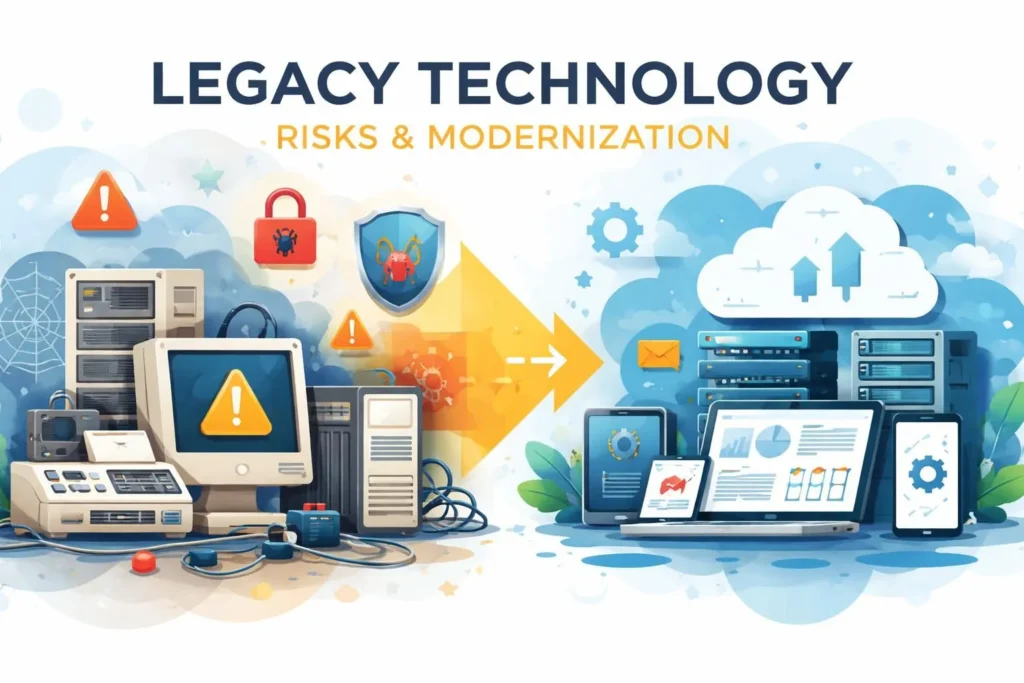
Legacy technology refers to any outdated software, hardware, or infrastructure that an organization continues to use despite the availability of more capable modern alternatives. In 2026, legacy technology is no longer just an IT concern — it is a boardroom-level business risk that directly affects security posture, operational efficiency, regulatory compliance, and an organization’s ability to compete in an AI-driven market.
What Is Legacy Technology? A Clear Definition for 2026
The word “legacy” implies heritage, but in technology contexts it carries a very different weight. A legacy system is not simply old — it is any technology that can no longer meet the demands of the business it serves. That distinction matters enormously, because it means a custom application built just five years ago can already qualify as legacy if it cannot integrate with your current tech stack, support real-time data flows, or meet modern security standards.
In 2026, “legacy” is defined by relevance, not age. A system becomes legacy when it can no longer meet what the business needs — modern API integration, real-time data flows, current security standards, or AI tooling.
Common examples of legacy technology include mainframe systems still running COBOL-based applications, on-premise ERP platforms that predate cloud computing, custom databases with no modern API layer, operating systems past their vendor end-of-life dates, and monolithic software architectures that cannot be updated without risking full system failure.
Legacy Technology vs. Legacy Systems vs. Technical Debt
These three terms are closely related but meaningfully different. Legacy technology is the broadest category — encompassing hardware, software, networks, and infrastructure. Legacy systems typically refers specifically to software applications and platforms. Technical debt is the accumulated cost and complexity that builds up when shortcuts are taken during development, or when systems are patched repeatedly instead of being properly modernized. All three problems tend to compound each other over time, and organizations carrying significant technical debt almost always have legacy technology at its root.
The True Cost of Legacy Technology: What Organizations Are Actually Paying
The financial impact of legacy technology is consistently underestimated because costs are distributed across multiple budget lines rather than sitting in a single visible “legacy” cost center. Organizations typically count what they pay directly for maintenance contracts, but the true picture includes engineering hours, security remediation, integration workarounds, compliance failures, and the lost productivity of employees working around system limitations.
Enterprises report losing approximately $370 million annually due to outdated technology and technical debt — a figure that encompasses maintenance, failed modernization attempts, and the ongoing operational drag that legacy environments impose on innovation.
A Deloitte study found that companies spend an average of 60 to 80 percent of their IT budgets simply to keep legacy systems running, leaving minimal room for innovation or modernization investment.
In government, the situation is even more acute. The U.S. Government Accountability Office reports that 80 percent of federal IT budgets go toward maintaining legacy systems, creating a cycle that starves innovation while continuously feeding outdated technology.
Hidden Costs That Most Organizations Overlook
Beyond the visible maintenance line items, legacy technology generates costs in several areas that rarely appear on a single budget report. Specialist knowledge scarcity is one of the most significant. Many IT professionals no longer work with outdated programming languages like COBOL or Fortran, making it difficult and expensive to find and retain qualified support staff.
Productivity loss compounds this problem at the employee level. Research from Forrester found that employees lose an average of 26 percent of their working week dealing with slow or outdated technology — time that could otherwise be directed toward high-value work.
Maintenance costs for legacy systems typically increase 10 to 15 percent annually, meaning the combined impact of rising maintenance, operational inefficiencies, security mitigation expenses, and workforce challenges causes the total cost of inaction to exceed the cost of modernization within two to three years.
Why Organizations Continue Using Legacy Technology
If the costs and risks are so well documented, why do so many organizations continue operating on outdated systems? The reasons are more rational than they might appear, and understanding them is essential to building a realistic modernization plan.
Sunk Cost and Return on Prior Investment
Legacy systems like ERP, CRM, or core banking software often required massive financial investments when first implemented. Many organizations hesitate to abandon them because they want to maximize returns on that initial capital outlay. This logic is understandable in isolation but becomes dangerous when the cost of maintaining the old system has already exceeded its original price multiple times over.
Embedded Business Logic and Workflow Dependency
Years of customization, regulatory adaptation, and workflow integration mean that legacy systems often contain business logic that is not properly documented anywhere else. Replacing the system means first understanding — and then reconstructing — every rule, exception, and process that was baked into the codebase over years of incremental modification. Over the years, entire workflows, compliance requirements, and business processes may have been built around legacy systems, making the prospect of replacement appear far more disruptive than simply maintaining the status quo.
Fear of Disruption to Mission-Critical Operations
For organizations where continuous operations are non-negotiable — banks, hospitals, utilities, government agencies — the fear of downtime during a migration is real and legitimate. The perception that any change introduces existential risk leads to indefinite postponement, even as the actual risk of maintaining the legacy system grows larger each year.
The Seven Core Risks of Legacy Technology in 2026
Understanding the specific risk categories that legacy technology creates allows organizations to prioritize modernization efforts based on where their actual exposure is greatest.
Cybersecurity Vulnerabilities
Legacy software often runs without current security patches, leaving known vulnerabilities open for exploitation. Cybercriminals actively target these weaknesses because they know many organizations have not updated their defenses.
AI-powered attack tools have lowered the barrier for cybercriminals significantly, and the average cost of a data breach has climbed to $4.88 million according to IBM’s latest research — yet organizations continue running systems like Windows Server 2012 and custom applications built on frameworks that have not been supported since 2019.
The 2025 Verizon Data Breach Investigations Report found that 68 percent of breaches involving legacy systems began with a compromised third-party component — a library, plugin, or dependency that also no longer receives security updates.
Regulatory Compliance Failures
A hospital relying on outdated patient record systems may struggle to meet HIPAA requirements. A bank still tied to legacy mainframes might not satisfy PCI DSS standards for payment security. Noncompliance can result in significant fines, lawsuits, and lasting reputational damage.
In the UK, the Information Commissioner’s Office issued approximately £41 million in legacy-attributable fines between 2024 and early 2026, reflecting the real financial consequence of operating non-compliant legacy infrastructure.
Integration Failure and Data Silos
Integrating legacy systems with modern applications or third-party services is increasingly challenging. The lack of standard APIs and compatibility issues between old and new technologies result in complex integration processes, hindering seamless workflows and data synchronization. This creates data silos — isolated pools of information that cannot be accessed, combined, or analyzed in real time.
Operational Inefficiency and Slow Innovation
Legacy software creates significant limitations for fast implementation of changes. All components are tightly coupled, making it difficult to predict system behavior even after small updates. Every new feature creates redundancy and carries potential risks, requiring extensive verification at each stage.
Outdated software typically does not support automated testing or modern deployment pipelines. As a result, each release requires extensive manual testing, increasing workload and the probability of human error — and most legacy systems lack reliable rollback mechanisms, adding an additional layer of operational risk.
Talent Acquisition and Retention Problems
Today’s workforce — particularly Millennials and Gen Z — are accustomed to modern tools. When skilled candidates discover during recruitment that an organization runs on clunky, outdated systems, many choose competitors with better technology infrastructure instead. This creates a compounding problem where the talent needed to maintain legacy systems is leaving the workforce through retirement just as demand for modern engineering skills intensifies.
AI Readiness Blockage
Legacy systems run on batch processing, siloed databases, and architectures designed for overnight data processing — not the millisecond inference that modern AI workloads require. AI-ready infrastructure needs real-time data access, clean API surfaces, and continuous model training pipelines. Most legacy systems cannot provide any of these capabilities.
Vendor Support Discontinuation
As legacy systems age, vendor support may diminish or be entirely discontinued. This leaves organizations reliant on outdated software or hardware without access to essential updates, patches, or technical assistance — making systems progressively more vulnerable to failure and security breach without any path to remediation through the original vendor.
Real-World Legacy Technology Failures: What the Case Studies Show
Abstract risk discussions become concrete when examined through the lens of actual failures that have cost organizations billions.
The UK Post Office Horizon scandal remains one of the most consequential legacy technology failures in recent history. Between 1999 and 2015, more than 900 subpostmasters were wrongfully convicted of theft, fraud, and false accounting based on faulty data from the Horizon accounting system — which was recording losses that never actually occurred. The human cost has been catastrophic: six former subpostmasters have died by suicide as a direct consequence, and around 10,000 people are now eligible for compensation. The scandal continues through courts and inquiry in 2026.
The Canadian Phoenix Pay System failure illustrates the operational risk dimension. A government payroll modernization project that failed to integrate with existing records caused massive payment errors — employees were underpaid, overpaid, or not paid at all. By 2023, the government had spent over $2.4 billion attempting to fix the issue.
On the cybersecurity front, the Colonial Pipeline ransomware attack in 2021 — made possible through an outdated VPN system with no multi-factor authentication — forced the company to pay $4.4 million in ransom and caused fuel distribution shutdowns across the U.S. East Coast.
Legacy Technology Across Industries: Where the Problem Is Most Acute
Legacy technology affects every sector, but the nature of the risk and the urgency of modernization varies significantly by industry.
Financial Services
Banking and financial services carry some of the heaviest legacy burdens globally. Core banking systems built on mainframe architectures from the 1980s and 1990s still process the majority of the world’s financial transactions. While these systems are extraordinarily stable, they are fundamentally incompatible with the real-time, API-driven architecture that modern digital banking and open finance regulations require. A global bank that migrated core platforms using hybrid cloud and zero trust architecture cut downtime by 70 percent and enabled new digital product launches — demonstrating what structured modernization delivers in practice.
Healthcare
EHR systems, patient management platforms, and billing tools built on outdated architectures create interoperability challenges and increase the risk of data breaches. The healthcare legacy modernization segment was projected to grow at an 18.40 percent CAGR through 2030, reflecting the scale of the modernization need across the sector.
Government
Government agencies face some of the most extreme legacy challenges. The GAO has identified critical federal systems running on technology from the 1960s and 1970. Budget constraints, procurement complexity, and the sheer scale of government IT infrastructure make modernization particularly challenging — but also particularly urgent.
Manufacturing
At least 40 percent of manufacturing units have relied on outdated software that no longer receives security updates or vendor support, including assembly line equipment, quality control systems, and industrial control systems. Modernization in manufacturing focuses on connecting operational technology with information technology to enable Industry 4.0 capabilities.
Legacy Technology Modernization: Strategies That Work
Modernization does not always mean replacing everything. The appropriate strategy depends on the system’s age, complexity, business criticality, and the organization’s risk tolerance. The framework most widely used in 2026 is the 7 Rs model, an evolution of Gartner’s original 5 Rs approach.
The 7 Rs Framework for Legacy Modernization
Rehosting — also called lift and shift — moves a system to new infrastructure with no code changes. It is the fastest and lowest-risk approach and is useful as a first step off aging hardware, though it does not address underlying structural problems.
Replatforming moves a system to a new environment while making targeted improvements, such as swapping a self-managed database for a managed cloud service without redesigning the overall architecture.
Refactoring involves restructuring the existing code to improve its design, maintainability, and performance without changing its external behavior. This approach preserves business logic while improving scalability and reducing technical debt.
Rearchitecting means redesigning the system at an architectural level — typically breaking a monolithic application into microservices or adopting an event-driven design. This is a more involved process, but the payoff is long-term agility and the ability to integrate new technologies as they emerge.
Rebuilding means developing new software from the ground up using modern languages, frameworks, and cloud-native architecture. This gives organizations complete control over architecture, user experience, performance, and compliance. The trade-off is time and cost, but for organizations constrained by deeply flawed legacy systems, rebuilding offers the cleanest path to transformation.
Replacing retires the legacy system in favor of an off-the-shelf or SaaS solution. This works best for non-core processes — like CRM or HRM platforms — that do not require heavy customization.
Retiring involves decommissioning applications that no longer provide sufficient value. Retiring duplicate or outdated systems enables organizations to reduce expenses while eliminating associated security risks from their risk surface.
The Strangler Fig Pattern
The Strangler Fig Pattern is one of the most practical approaches for large, high-risk systems. Instead of replacing the entire legacy system in a single migration, new functionality is gradually built around the existing system. Over time, the legacy system is “strangled” as its responsibilities are transferred to the new architecture — making it ideal for systems deeply integrated with business-critical operations that cannot tolerate downtime.
Encapsulation and API Wrapping
Encapsulation extends the life of legacy applications by wrapping them in modern APIs that allow newer systems to communicate with them. This does not solve the underlying architectural problem, but it allows organizations to integrate legacy data sources with modern tools while planning a longer-term migration — a pragmatic bridge strategy that delivers near-term value without requiring immediate full replacement.
How AI Is Accelerating Legacy Technology Modernization
AI and automation are transforming legacy system modernization by accelerating code migration, improving analytics, and reducing manual errors. AI can scan legacy code to identify dependencies, bugs, and modernization candidates. Machine learning tools translate or refactor code for cloud compatibility. Generative AI supports rewriting legacy code, generating documentation, and automating quality assurance processes that previously required extensive manual effort.
McKinsey’s April 2026 research identified “deliberate modernizers” as the organizations worth emulating: those that allocate at least one-third of their technology budgets to change, keep run costs at least 20 percent lower than peers, and replace legacy systems rather than layer new capabilities on top. The relationship between modernization and AI readiness is becoming circular — modernization frees up budget for AI adoption, and AI makes further modernization faster and cheaper.
Building a Legacy Technology Modernization Roadmap
A successful modernization roadmap begins with accurate assessment, not with technology selection. Organizations that skip the assessment phase consistently underestimate the complexity of what they are dealing with, leading to budget overruns, scope creep, and failed migrations.
Step One: Conduct a Full System Audit
Map every application, infrastructure component, and data source in the current environment. Identify dependencies between systems, document the business logic embedded in each application, and catalog integration points. Without a full audit of your codebase, infrastructure, and data flows, you are effectively navigating blind — and one of the biggest failure modes in modernization projects is underestimating the complexity of the current system before committing to a strategy.
Step Two: Prioritize by Risk and Business Value
Not every legacy system carries equal urgency. Systems with active cybersecurity vulnerabilities, compliance obligations, or direct customer impact deserve immediate attention. Systems that are old but isolated, have limited integration with other platforms, and carry manageable risk can be addressed in later phases. Selective modernization prioritizes modules tied to strategic capabilities — such as payments, customer onboarding, or core product catalog — rather than attempting to modernize the entire platform simultaneously.
Step Three: Choose Incremental Over Big Bang
Legacy modernization projects fail more often than they succeed when the “big bang” approach is used. Attempting to modernize everything at once creates enormous risk — if the migration fails, there is no fallback. Incremental approaches that prove value early and scale from there consistently deliver better outcomes.
Step Four: Embed Security by Design
Modern security architecture built around zero trust — which assumes no implicit trust for users or devices — should be designed into new components from the start, not retrofitted after migration is complete. Zero trust is becoming the de facto standard for resilient systems precisely because the perimeter-based security models that legacy architectures relied on are insufficient for distributed, cloud-connected environments.
Step Five: Address Change Management as a Primary Workstream
Modernization is as much a people challenge as a technology challenge. Employees who have used the same system for years will resist change unless they understand why it is happening and how the new system will make their work easier. Ignoring change management is one of the most consistent failure modes in modernization projects — it is not a soft issue that can be addressed after technical work is complete.
Legacy Technology Modernization Trends Shaping 2026 and Beyond
The legacy modernization market stood at $24.98 billion in 2025 and is projected to reach $56.87 billion by 2030 — reflecting the scale of investment that organizations across every sector are committing to technology transformation.
The global application modernization market is projected to grow from $30 billion in 2026 to $92 billion by 2034. Enterprises that prioritize legacy application modernization report 30 to 50 percent faster release cycles and up to 75 percent reductions in IT infrastructure costs — figures that make the business case for modernization increasingly difficult to ignore at the executive level.
Cloud-native architecture, composable API-driven design, zero trust security, AI-assisted code migration, and real-time data operations are the five forces defining what modernization looks like in practice during this period. In 2026, modernization has transitioned from a reactive necessity to a strategic enabler of business outcomes — and the organizations leading in their markets are the ones that recognized this shift earliest.
Frequently Asked Questions About Legacy Technology
What is the simplest definition of legacy technology? Legacy technology is any system, software, or hardware that an organization continues to use even though it can no longer adequately meet current business needs — whether due to security limitations, integration failures, compliance gaps, or inability to support modern workloads like real-time data processing and AI.
How do you know if a system qualifies as legacy? A system is effectively legacy if it no longer receives vendor security updates, cannot integrate with modern tools through standard APIs, requires specialist knowledge in outdated programming languages to maintain, prevents the adoption of cloud or AI capabilities, or consistently generates compliance risk in regulated environments.
Is legacy technology always a problem that needs to be fixed immediately? Not always. Some legacy systems run stable, isolated workloads with limited security exposure and can be maintained acceptably while higher-priority systems are modernized first. The key is conducting an honest risk assessment to distinguish between legacy systems that represent urgent threats and those that can be addressed through a phased roadmap.
What is the most common reason legacy technology modernization projects fail? The most common failure modes are attempting too much at once with a “big bang” migration approach, underestimating the complexity of the existing system before the project begins, failing to document and preserve critical business logic during migration, and treating change management as secondary to the technical work rather than as a parallel and equally important workstream.
How long does a legacy technology modernization project typically take? Timeline varies enormously based on system complexity, organizational size, and the modernization approach chosen. Targeted refactoring or replatforming of a single system can be completed in months. Full rearchitecting of a core business platform typically spans one to three years. Enterprise-wide transformation programs in large organizations often run over multiple years with staggered phases.
What role does AI play in legacy technology modernization today? AI is now an active accelerator of modernization itself — not just a reason to modernize. Generative AI tools can analyze legacy codebases, identify dependencies, translate code from outdated languages to modern equivalents, auto-generate documentation, and flag security vulnerabilities at speeds that were previously impossible. For organizations facing the challenge of modernizing undocumented systems built in languages for which expertise is scarce, AI-assisted code analysis has become a genuinely transformative capability.
What is technical debt and how does it relate to legacy technology? Technical debt is the accumulated cost of deferred improvements — shortcuts taken during development, systems patched repeatedly instead of properly updated, and integrations built as workarounds rather than proper architectural solutions. Legacy technology is the physical manifestation of unresolved technical debt, and addressing one requires addressing the other. Organizations that modernize a legacy system without also changing how they manage technical debt through ongoing engineering practices typically find themselves accumulating new legacy systems over the following years.