 CelebriHubTeam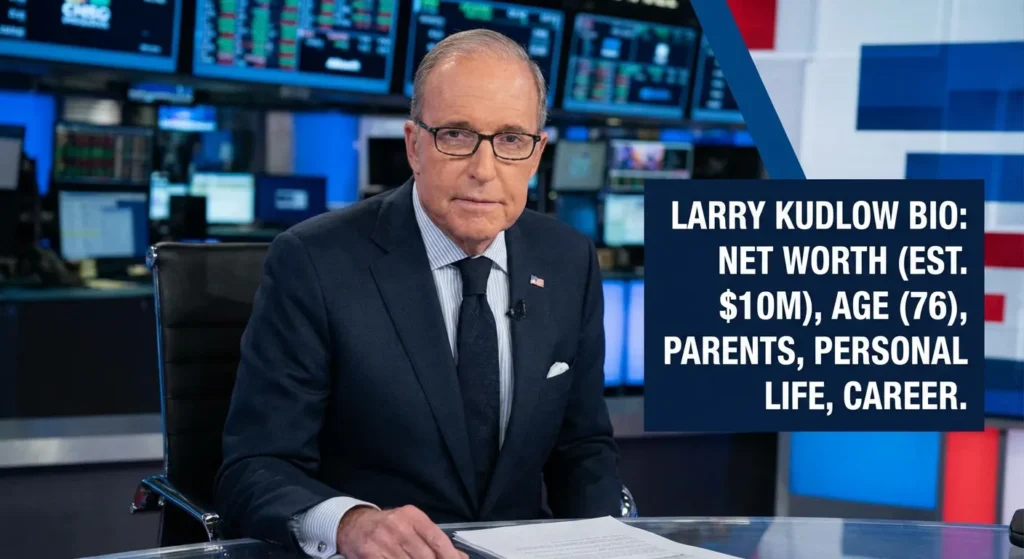
Larry Kudlow stands as one of America’s most influential conservative economists, with a career spanning Wall Street, government service, and media that has shaped economic policy debates for over four decades. From his early days as a Federal Reserve economist to serving as Director of the National Economic Council under President Trump, Kudlow’s journey offers a compelling narrative of professional achievement, personal redemption, and enduring influence in financial journalism.
The question of Larry Kudlow’s net worth attracts attention not merely for financial curiosity, but because his wealth trajectory reflects the broader story of American economic conservatism, media influence, and the intersection of policy and markets. With an estimated net worth of $5 million as of 2026 and continued prominence as a Fox Business host, Kudlow remains a vital voice in debates surrounding tax policy, deregulation, and free-market capitalism.
This comprehensive analysis examines Larry Kudlow’s net worth, salary history across CNBC and Fox Business, his transformative government service, personal challenges including substance abuse recovery, and the economic philosophy that has defined his career. Whether you’re interested in his Reagan-era policy work, his CNBC broadcasting legacy, or his current role shaping conservative economic discourse, this article provides authoritative, fact-based insights into one of financial media’s most distinctive personalities.
Who Is Larry Kudlow? Biography & Personal Information
Larry Kudlow, born Lawrence Alan Kudlow on August 20, 1947, in New Jersey, has built a multifaceted career as an economist, television personality, newspaper columnist, and government advisor. His intellectual journey from academic economics to Wall Street analysis to conservative policy advocacy represents a unique American success story marked by both professional triumph and personal struggle.
Personal Information & Background
| Personal Details | Information |
|---|---|
| Full Name | Lawrence Alan “Larry” Kudlow |
| Date of Birth | August 20, 1947 |
| Birth Place | New Jersey, USA |
| Age (2026) | 78 years |
| Nationality | American |
| Religion | Jewish (raised), Catholic (converted) |
| Education | University of Rochester (B.A. History, 1969) |
| Graduate Study | Princeton University Woodrow Wilson School |
| Occupation | Economist, Television Host, Columnist, Policy Advisor |
| Current Position | Fox Business Host, Radio Host 77WABC |
| Previous Government Role | Director, National Economic Council (2018-2021) |
| Spouse | Judith Pond (married 1986) |
| Children | Not publicly disclosed |
| Awards | Bishop’s Humanitarian Award, Ronald Reagan Freedom Award |
| Net Worth (2026) | $5 million |
| Annual Salary | $800,000 (CNBC historical), current Fox salary undisclosed |
Early Life & Educational Foundation
Growing up in a Jewish family in New Jersey, Kudlow attended prestigious private schools including Elizabeth Morrow School and Dwight-Englewood School, which provided a strong educational foundation. His intellectual curiosity led him to the University of Rochester, where he graduated in 1969 with a degree in history—not economics, which would later become his professional focus.
Following graduation, Kudlow pursued advanced studies at Princeton University’s Woodrow Wilson School of Public and International Affairs, studying politics and economics. This interdisciplinary approach, combining political theory with economic analysis, would characterize his career approach of viewing markets through both technical and ideological lenses.
Early Political Involvement
Interestingly, Kudlow’s early political work aligned with liberal Democratic causes—a stark contrast to his later conservative identity. In 1970, he worked on Joseph Duffey’s U.S. Senate campaign alongside future political figures Bill Clinton, John Podesta, and Michael Medved. This experience in Democratic politics provided insights into campaign strategy and policy advocacy that would later inform his conservative messaging.
His political evolution from liberal Democrat to Reagan conservative represents one of the most significant ideological transformations in modern American political economics, mirroring the broader “neoconservative” movement of former liberals who embraced free-market policies during the 1970s and 1980s.
Larry Kudlow Net Worth 2026: Financial Overview
As of 2026, Larry Kudlow’s estimated net worth stands at $5 million, according to his September 2019 financial disclosure and subsequent reporting. This figure, while substantial, positions him below many Wall Street executives and some media personalities, reflecting the financial impact of his government service years and personal challenges that interrupted his private-sector career trajectory.
Net Worth Breakdown by Asset Category
Liquid Assets & Stock Holdings: Kudlow’s 2019 financial disclosure revealed stock holdings and liquid assets worth a minimum of $2 million. These investments likely include:
- Blue-chip equities reflecting his pro-growth investment philosophy
- Conservative bond allocations appropriate for his age
- Mutual funds and index funds
- Retirement accounts accumulated across multiple careers
Real Estate Holdings: His primary residence in Redding, Connecticut, purchased in 1987 for $606,000, now holds an estimated value of $2 million. This 3.4-acre property features a 6,000-square-foot home and represents significant appreciation over the 39-year ownership period.
Income-Producing Assets: Speaking fees, book royalties from publications including “American Abundance” and “JFK and the Reagan Revolution,” and consulting work contribute ongoing income beyond salary.
Net Worth Variation Across Sources
Different sources report varying net worth estimates for Kudlow:
- Conservative estimate: $5 million (based on official disclosures)
- Mid-range estimate: $10 million (including undisclosed assets)
- High estimate: $80 million (likely inaccurate, appears in some online databases)
The $5 million figure from his official 2019 financial disclosure represents the most credible estimate, as government officials must report assets within specific ranges under federal ethics requirements. The higher estimates may conflate net worth with lifetime earnings or include speculative valuations.
Comparison to Financial Media Peers
Larry Kudlow’s $5 million net worth is modest compared to some financial media personalities:
- Jim Cramer (CNBC): $150 million (includes hedge fund wealth)
- Maria Bartiromo (Fox Business): $50 million
- Neil Cavuto (Fox Business): $27 million
- Stuart Varney (Fox Business): $10 million
- Larry Kudlow: $5 million
This comparison reveals that Kudlow’s wealth accumulation focused less on maximizing personal fortune and more on policy influence, with significant career years spent in lower-paying government service rather than maximizing Wall Street or media earnings.
Larry Kudlow Salary: CNBC, Government & Fox Business Earnings
CNBC Salary & Compensation (2001-2018)
During his 17-year tenure at CNBC, Larry Kudlow earned $800,000 annually according to his financial disclosure. This salary compensated him for hosting multiple shows including:
- “Kudlow & Cramer” (2002-2005)
- “The Kudlow Report” (2005-2014)
- Various CNBC contributions and appearances (2014-2018)
Additional CNBC-Era Income:
- Speaking fees: $100,000-$200,000 annually
- Consulting work: Undisclosed amounts
- Syndicated column income: Estimated $50,000-$100,000
Total annual CNBC-era income likely ranged from $1 million to $1.2 million when combining all sources.
National Economic Council Director Salary (2018-2021)
When President Trump appointed Kudlow as Director of the National Economic Council in March 2018, his compensation dropped dramatically to $185,000 annually—the standard salary for senior White House positions. This represented a pay cut of over 75% from his CNBC earnings, demonstrating his commitment to public service over personal financial gain.
During this three-year period, Kudlow sacrificed approximately $2.4 million in lost income compared to his CNBC salary, not including lost speaking fees and consulting opportunities that ethics rules prohibited.
Fox Business Salary & Current Compensation (2021-Present)
After leaving the White House in January 2021, Kudlow joined Fox Business Network as host of “Kudlow,” airing weekdays at 4 PM ET. While Fox has not publicly disclosed his current salary, industry estimates suggest:
- Estimated annual salary: $800,000-$1.5 million
- Radio show compensation (77WABC): $100,000-$200,000
- Speaking engagements: $150,000-$300,000 annually
- Book royalties: $50,000-$100,000 annually
Total estimated current annual income: $1.1 million to $2.1 million
This places Kudlow among the higher-earning Fox Business personalities, though below marquee names like Maria Bartiromo ($10 million) and likely comparable to Neil Cavuto ($7 million reported salary).
Career Journey: From Federal Reserve to Fox Business
Federal Reserve Bank of New York (Late 1960s-Early 1970s)
Kudlow’s professional career began as a staff economist at the Federal Reserve Bank of New York, where he gained technical expertise in monetary policy, banking regulation, and economic analysis. This foundational experience provided deep understanding of central banking operations that would inform his later critiques of Federal Reserve policy.
Nixon Administration & Early Political Work (1970)
In 1970, Kudlow moved into political economics, joining President Richard Nixon’s administration as a junior economist. This early government experience exposed him to policy-making processes and the relationship between political priorities and economic outcomes.
Bear Stearns: Rise & Fall (1987-1994)
In 1987, Kudlow joined Bear Stearns as chief economist and senior managing director, a prestigious position at one of Wall Street’s premier investment banks. During this seven-year period, he:
- Provided economic forecasts and market analysis for institutional clients
- Represented Bear Stearns in media appearances
- Contributed to the firm’s strategic economic thinking
- Built a reputation as a supply-side economics advocate
However, this successful period ended abruptly in 1994 when Bear Stearns terminated Kudlow due to cocaine addiction. The dismissal followed his missing an extremely important client presentation because of substance abuse, marking the lowest point in his professional and personal life.
Substance Abuse, Recovery & Redemption (1994-2001)
Kudlow’s termination from Bear Stearns initiated a period of personal crisis but ultimately led to profound transformation. He publicly confronted his cocaine and alcohol addiction, entered treatment, and achieved lasting sobriety. His recovery included:
- Joining Alcoholics Anonymous and maintaining sobriety
- Converting from Judaism to Catholicism
- Rebuilding professional credibility through consulting work
- Serving as economic counsel to A.B. Laffer & Associates
- Contributing to conservative publications and think tanks
This period of redemption demonstrated remarkable resilience and would later inform his compassionate approach to discussing addiction as a disease requiring treatment rather than moral judgment.
CNBC Broadcasting Career (2001-2018)
Kudlow’s media career began in earnest when CNBC recognized his unique combination of Wall Street expertise, economic philosophy, and telegenic communication style. His CNBC shows became platforms for advocating supply-side economics and critiquing government intervention:
“Kudlow & Cramer” (2002-2005): Paired with Jim Cramer, this show combined Kudlow’s macro-economic analysis with Cramer’s stock-picking approach, creating dynamic on-air chemistry that attracted substantial viewership.
“The Kudlow Report” (2005-2014): After Cramer left to host “Mad Money,” the show was renamed and focused exclusively on Kudlow’s economic commentary, policy analysis, and interviews with business leaders and policymakers.
CNBC Contributor (2014-2018): Following the end of his named show, Kudlow remained a senior contributor, appearing regularly to discuss economic policy and market developments.
Throughout his CNBC career, Kudlow became known for:
- Unwavering optimism about American economic potential
- Advocacy for tax cuts and deregulation
- Criticism of Federal Reserve monetary policy
- Support for strong dollar policies
- Interviews with major political and business figures
Director of National Economic Council (2018-2021)
President Trump appointed Kudlow as Director of the National Economic Council in March 2018, replacing Gary Cohn. In this role, Kudlow:
- Coordinated administration economic policy across federal agencies
- Advised the president on tax policy, trade negotiations, and regulatory reform
- Served as public spokesman for Trump’s economic agenda
- Participated in trade negotiations with China, Mexico, and Canada
- Advocated for the 2017 Tax Cuts and Jobs Act implementation
Key Policy Achievements:
- Supporting corporate tax reduction from 35% to 21%
- Advocating deregulation across multiple sectors
- Defending tariff policies during U.S.-China trade tensions
- Promoting economic growth targets of 3-4% GDP annually
Kudlow’s government service reinforced his status as a leading conservative economist while exposing him to criticism for optimistic economic projections that didn’t always materialize, including predictions of 5% GDP growth that never occurred.
Fox Business & Current Media Work (2021-Present)
After leaving the White House, Kudlow returned to broadcasting with “Kudlow” on Fox Business Network, where he continues providing economic commentary from a conservative perspective. His current work includes:
- “Kudlow” (Fox Business): Weekday 4 PM ET show covering markets, policy, and politics
- “The Larry Kudlow Show” (77WABC Radio): Saturday 10 AM-1 PM ET radio program
- Speaking engagements: Regular appearances at conservative conferences and business events
- Writing: Columns and articles for conservative publications
His Fox Business platform allows continued advocacy for supply-side economics, criticism of Biden administration policies, and commentary on Federal Reserve decisions, maintaining his role as a prominent conservative economic voice.
Economic Philosophy: Supply-Side Economics & Policy Positions
Core Economic Beliefs
Larry Kudlow’s economic worldview centers on supply-side economics, also called “Reaganomics” after President Reagan’s economic policies. Key principles include:
Tax Cuts as Growth Drivers: Kudlow believes reducing tax rates, particularly on capital gains and corporate income, stimulates investment, entrepreneurship, and economic expansion. Lower taxes increase after-tax returns, incentivizing productive economic activity.
Deregulation: Government regulations impose costs on businesses that reduce efficiency and innovation. Removing unnecessary regulations unleashes entrepreneurial energy and market dynamism.
Free Trade with Strategic Protectionism: While generally supporting free trade, Kudlow backed Trump’s tariff policies when framed as negotiating leverage to achieve fairer trade agreements, particularly with China.
Strong Dollar Policy: A stable, strong dollar benefits the U.S. economy by maintaining purchasing power, attracting foreign investment, and reinforcing the dollar’s status as the global reserve currency.
Limited Government Intervention: Markets generally allocate resources more efficiently than government planners. Economic policy should focus on creating conditions for private-sector growth rather than direct government spending.
Policy Positions Throughout Career
1980s Reagan Administration: As associate director for economics and planning at the Office of Management and Budget, Kudlow helped develop Reagan’s tax-cutting agenda, supporting the Economic Recovery Tax Act of 1981 that reduced top marginal rates from 70% to 50%.
1990s-2000s Media Advocacy: Through CNBC and syndicated columns, Kudlow consistently advocated for:
- Capital gains tax reductions
- Corporate tax reform
- Social Security privatization proposals
- Criticism of Federal Reserve interest rate policies
- Opposition to government stimulus spending
Trump Administration (2018-2021): Kudlow supported and defended:
- 2017 Tax Cuts and Jobs Act
- Regulatory rollback across agencies
- Trade tariffs as negotiating tools
- COVID-19 economic relief measures (despite previous opposition to stimulus)
- Optimistic GDP growth forecasts
Criticisms & Controversies
Kudlow’s economic predictions have faced criticism for excessive optimism:
- Predicted 2008 financial crisis would be mild when it became severe
- Consistently forecast GDP growth rates higher than actual outcomes
- Initially downplayed COVID-19 economic impact in early 2020
- Defended tax cut revenue effects that didn’t materialize as projected
Critics argue his ideological commitment to supply-side economics sometimes overrides empirical evidence, though supporters view his optimism as valuable for business confidence and investment decisions.
Books, Publications & Thought Leadership
Authored Books
“American Abundance: The New Economic and Moral Prosperity” (2015) This book argues that free-market capitalism generates not only material prosperity but also moral benefits by rewarding hard work, innovation, and responsible risk-taking. Kudlow connects economic freedom with traditional values, appealing to both economic conservatives and social conservatives.
“JFK and the Reagan Revolution: A Secret History of American Prosperity” (2016) Kudlow traces supply-side economics to President Kennedy’s tax-cutting policies, arguing that Reagan’s economic revolution built on Democratic precedents. This historical argument attempts to depoliticize supply-side economics by showing bipartisan origins.
“Tide: Why Tax Cuts Are the Key to Prosperity and Freedom” (co-authored) This work provides detailed economic analysis supporting tax reduction as the primary driver of economic growth, labor market expansion, and rising living standards.
Syndicated Columns & Editorial Work
Throughout his career, Kudlow has written for:
- National Review: Senior editor and frequent contributor to this leading conservative magazine
- National Review Online: Economics editor providing regular market and policy commentary
- Syndicated columns: Distributed to newspapers nationwide covering economic policy and market analysis
His writing style combines technical economic analysis with accessible explanations designed for general audiences, making complex policy debates understandable to non-economists.
Think Tank Affiliations
- America First Policy Institute: Senior fellow focusing on economic policy
- Empower America: Former board of directors member
- Various conservative policy organizations: Regular speaker and advisor
These affiliations maintain his influence in conservative policy circles beyond media appearances and government service.
Personal Life: Family, Faith & Community Involvement
Marriage & Family
Larry Kudlow married Judith Pond in 1986, during his period at Bear Stearns. Their marriage survived his substance abuse crisis and professional setbacks, with Judith providing crucial support during his recovery. The couple maintains privacy regarding children and detailed family matters, consistent with Kudlow’s general reluctance to discuss personal life in media appearances.
Religious Conversion & Spiritual Life
Kudlow’s conversion from Judaism to Catholicism occurred during his recovery from addiction, representing profound spiritual transformation. His Catholic faith became integral to his recovery and worldview, connecting economic philosophy with moral principles.
Religious Community Involvement:
- President, St. Patrick’s Church Parish Council (Redding, Connecticut): Leadership role in local Catholic community
- Bishop’s Humanitarian Award (Catholic Charities of Brooklyn & Queens): Recognition for charitable work
- Ambassadors for Mission Award (Pontifical Mission Societies): Acknowledgment of faith-based service
This religious dimension adds depth to Kudlow’s public persona, distinguishing him from purely secular conservative economists.
Awards & Recognition
Beyond religious honors, Kudlow has received:
- Ronald Reagan Freedom Award (Texas Public Policy Foundation): Recognition as leading voice for Reagan-style conservative economics
- New York Police Department Holy Name Society’s Lifetime Achievement Award: Community service recognition
- Fordham University Board of Trustees: Service to Catholic higher education
These awards reflect respect within conservative, Catholic, and law enforcement communities that value his economic views and personal redemption story.
Real Estate Holdings & Assets
Redding, Connecticut Primary Residence
In 1987, during his Bear Stearns tenure, Kudlow purchased a 3.4-acre property in Redding, Connecticut for $606,000. This substantial estate features:
- 6,000-square-foot main residence
- Extensive grounds in affluent Fairfield County community
- Privacy and space reflecting successful Wall Street career
- Current estimated value: $2 million
The property’s appreciation from $606,000 to approximately $2 million over 39 years represents a 230% increase, though this lags behind broader Connecticut real estate appreciation in some markets, possibly due to rural location versus coastal Connecticut.
Redding, Connecticut, is an affluent community known for:
- Privacy and large estates
- Proximity to New York City (approximately 60 miles)
- Natural beauty and rural character
- High-quality schools and low crime rates
Investment Real Estate
Public records don’t indicate additional real estate holdings beyond the primary residence, suggesting Kudlow’s wealth is concentrated in liquid assets and this single property rather than diversified real estate portfolios common among wealthier Wall Street figures.
Larry Kudlow vs Other Economic Commentators: Comparison
| Economic Commentator | Primary Platform | Estimated Net Worth | Background | Economic Philosophy |
|---|---|---|---|---|
| Larry Kudlow | Fox Business | $5 million | Bear Stearns economist, NEC Director | Supply-side, tax cuts, deregulation |
| Paul Krugman | New York Times | $5 million | Princeton professor, Nobel laureate | Keynesian, government intervention |
| Jim Cramer | CNBC | $150 million | Hedge fund manager, attorney | Stock picking, active trading |
| Mohamed El-Erian | Bloomberg Opinion | $50 million | PIMCO CEO, academic | Macro strategy, global markets |
| Larry Summers | Harvard, Washington Post | $40 million | Treasury Secretary, Harvard president | Centrist Democrat, technocratic |
| Art Laffer | Conservative think tanks | $10 million | USC professor, Reagan advisor | Supply-side originator, Laffer Curve |
This comparison reveals Kudlow’s unique position as a media-focused supply-side advocate with significant government experience but modest wealth compared to hedge fund managers or academic economists who commanded higher compensation.
Controversies & Public Criticism
Economic Forecast Accuracy
Kudlow has faced criticism for optimistic economic forecasts that didn’t materialize:
- 2007-2008 Financial Crisis: Initially downplayed housing market concerns and predicted mild recession when severe crisis occurred
- GDP Growth Projections: Consistently forecast 3-5% annual growth rates that rarely materialized
- COVID-19 Economic Impact: Early 2020 statements minimizing pandemic’s economic damage proved wrong
- Tax Cut Revenue Effects: Predicted 2017 tax cuts would generate revenue through growth; deficits increased instead
Supporters argue economic forecasting is inherently uncertain and Kudlow’s optimism serves valuable psychological function in maintaining business confidence, while critics view repeated overly optimistic projections as ideologically driven rather than empirically grounded.
Political Partisanship
Kudlow’s evolution from Democratic campaign worker in 1970 to staunch conservative advocate raises questions about intellectual consistency versus political opportunism:
- Critics argue his views shifted to align with Republican power centers
- Supporters view his transformation as genuine intellectual evolution based on empirical evidence about market superiority
- His unwavering support for Trump policies, even when contradicting previous positions (like opposition to tariffs), drew criticism from free-market purists
Substance Abuse & Recovery
While Kudlow’s candor about addiction recovery has been praised as reducing stigma, his 1994 termination from Bear Stearns for cocaine abuse damaged his reputation among Wall Street professionals. However, his sustained sobriety and professional comeback has largely transformed this narrative into a redemption story that enhances rather than diminishes his public standing, particularly among audiences valuing second chances and personal transformation.
Smart Answer
Larry Kudlow’s $5 million net worth reflects a career prioritizing policy influence over wealth maximization, with significant years in lower-paying government service interrupting private-sector earnings potential. His $800,000 CNBC salary and current Fox Business compensation position him as well-compensated but below top-tier financial media personalities like Jim Cramer or Maria Bartiromo. The economist’s supply-side philosophy emphasizing tax cuts, deregulation, and limited government intervention has remained consistent across Wall Street, media, and government roles spanning five decades. His personal redemption story overcoming cocaine addiction to achieve lasting sobriety and professional comeback demonstrates resilience while reducing stigma around substance abuse treatment. Real estate holdings centered on a $2 million Connecticut estate purchased in 1987 provide stable wealth foundation alongside liquid investment portfolios and ongoing income from Fox Business, radio, speaking fees, and book royalties.
Frequently Asked Questions
What is Larry Kudlow’s net worth in 2026?
Larry Kudlow’s net worth is estimated at $5 million as of 2026, based on his 2019 financial disclosure showing minimum $2 million in liquid assets plus his Redding, Connecticut real estate valued at approximately $2 million. This figure represents accumulated wealth from Wall Street, CNBC, government service, and current Fox Business career.
How much does Larry Kudlow make per year?
Larry Kudlow earned $800,000 annually during his CNBC tenure (2001-2018) plus $100,000-$200,000 from speaking fees. His government salary as National Economic Council Director was $185,000 (2018-2021). Current Fox Business salary is undisclosed but estimated at $800,000-$1.5 million annually, plus radio and speaking income.
What happened to Larry Kudlow at Bear Stearns?
Larry Kudlow was fired from Bear Stearns in 1994 due to cocaine addiction after missing an important client presentation. This termination marked his career low point but preceded his successful recovery, sobriety, and eventual comeback in media and government service.
Is Larry Kudlow still on Fox Business?
Yes, Larry Kudlow currently hosts “Kudlow” on Fox Business Network weekdays at 4 PM ET and “The Larry Kudlow Show” on 77WABC Radio Saturday mornings. He joined Fox Business in 2021 after leaving his position as Director of the National Economic Council.
What is Larry Kudlow’s economic philosophy?
Larry Kudlow advocates supply-side economics emphasizing tax cuts, particularly on capital gains and corporate income, deregulation to unleash entrepreneurship, free trade with strategic protectionism, strong dollar policy, and limited government intervention in markets to maximize economic growth.
Did Larry Kudlow work for President Trump?
Yes, Larry Kudlow served as Director of the National Economic Council from March 2018 to January 2021, advising President Trump on economic policy including tax reform, trade negotiations, regulatory rollback, and COVID-19 economic response measures.
Where does Larry Kudlow live?
Larry Kudlow lives in Redding, Connecticut, on a 3.4-acre estate featuring a 6,000-square-foot home that he purchased in 1987 for $606,000 and is currently valued at approximately $2 million.
What books has Larry Kudlow written?
Larry Kudlow authored “American Abundance: The New Economic and Moral Prosperity,” “JFK and the Reagan Revolution: A Secret History of American Prosperity,” and co-authored “Tide: Why Tax Cuts Are the Key to Prosperity and Freedom.”
Conclusion
Larry Kudlow’s $5 million net worth and four-decade career trajectory offer a compelling case study in the intersection of economic policy, media influence, and personal resilience. From Federal Reserve economist to Bear Stearns chief economist, from public struggle with cocaine addiction to sustained recovery, from CNBC host to White House economic advisor, and finally to Fox Business commentator, Kudlow’s journey reflects both the rewards and limitations of a career prioritizing policy advocacy over wealth accumulation.
His unwavering commitment to supply-side economics—tax cuts, deregulation, and free markets—has provided intellectual consistency across diverse roles while attracting both devoted followers and sharp critics. Whether his optimistic economic forecasts represent valuable confidence-building or ideological bias remains debated, but his influence on conservative economic thought is indisputable.
For those interested in economic policy, financial journalism, or the rehabilitation possibilities following substance abuse, Larry Kudlow’s story demonstrates that career setbacks need not be permanent, that intellectual conviction can survive professional transitions, and that media platforms combined with government experience can amplify policy influence beyond what wealth alone provides.
As he continues hosting “Kudlow” on Fox Business and “The Larry Kudlow Show” on 77WABC Radio, this 78-year-old economist remains actively engaged in debates shaping American economic policy, proving that influence and impact often matter more than net worth in measuring a career’s true value.
About the Author