What Is a Hopeless Romantic? Meaning, Signs, Traits & How to Love Smarter
You cry at the end of every rom-com even when you’ve watched it four times. You still believe in love letters, slow dances in the kitchen, and the kind of connection that feels like it was written in the stars. You’ve probably planned your dream wedding down to the centerpieces — and you may not even be engaged yet.
If any of that feels familiar, there’s a very good chance you’re a hopeless romantic. But what does that really mean? Is it a beautiful personality trait or a recipe for heartbreak? And can someone who lives and breathes romance actually build a stable, lasting relationship?
This complete guide covers everything you need to know about the hopeless romantic meaning, the signs and traits that define one, the psychology behind this personality type, the genuine strengths and challenges it brings — and how hopeless romantics can channel their gift for love in ways that lead to real, deeply fulfilling relationships.
What Is a Hopeless Romantic? (The Real Definition)
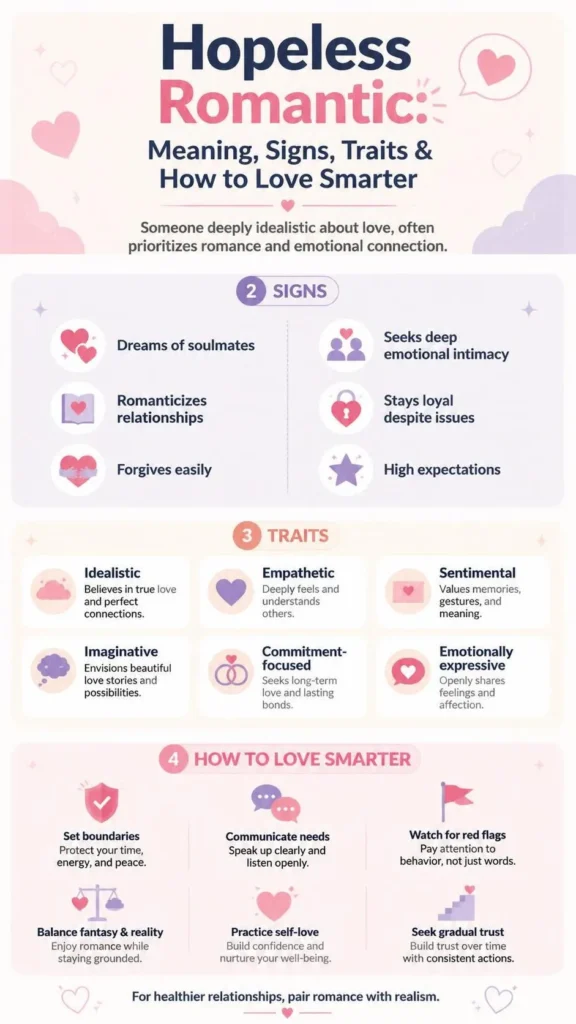
A hopeless romantic is someone who views love through an idealistic, deeply optimistic lens. They believe in soulmates, grand gestures, and the idea that love — when it is real — should feel extraordinary. For a hopeless romantic, love is not just one part of life. It is the most meaningful, transformative, and worth-protecting part of being human.
The term gets its name not from hopelessness in the negative sense — despair, defeat, or giving up — but from the idea of being helplessly devoted to romance. A hopeless romantic cannot help but believe in love’s power. They are, in a sense, lost to it — and they wouldn’t have it any other way.
Unlike a realist who approaches relationships with caution, logic, and practicality, or a cynic who has built walls after being burned, a hopeless romantic leads with their whole heart every single time. They fall in love easily. They feel deeply. They give generously. And even after heartbreak — sometimes especially after heartbreak — they dust themselves off and believe again.
In pop culture, the hopeless romantic is the lead of every beloved love story: Elizabeth Bennet holding out for a love that matches her soul in Pride and Prejudice, Noah building Allie a house in The Notebook, every character who stands in the rain to declare feelings they can no longer keep inside. We are collectively drawn to the hopeless romantic because somewhere in most of us, that person lives too.
The Origin and Evolution of the Term “Hopeless Romantic”
The phrase “hopeless romantic” has been in use in English since at least the 19th century, though its cultural saturation is largely a modern phenomenon. Historically, it described someone so devoted to the ideals of courtly love and romantic literature — the world of Shakespeare, Keats, Shelley, and the Brontës — that they were considered impractical for everyday life.
Over time, the phrase evolved from a gentle criticism into something more affectionately complex. Today it is equally a self-identifier, a relationship archetype, a pop culture trope, and a psychological personality type. When someone says “I’m a hopeless romantic,” they are rarely expressing shame. They are, most often, claiming it as a part of their identity with a mixture of pride and self-awareness.
The hopeless romantic today exists on a spectrum. At one end is someone who simply loves romance, gestures, and deep emotional connection — a person whose idealism enriches their relationships. At the other end is someone whose idealization of love leads to repeated disappointment, difficulty accepting partners as they truly are, or a pattern of rushing into relationships before genuine compatibility has been established. Understanding where on that spectrum you fall is key to turning your romantic nature from a vulnerability into a superpower.
15 Signs You Are a Hopeless Romantic
Many people wonder whether the label actually fits them. These fifteen signs are the most consistent characteristics shared by hopeless romantics — the ones that show up across studies of romantic personality, attachment research, and relationship behavior.
You believe in love at first sight. When a hopeless romantic sees someone across a room, they do not think “let me get to know this person slowly and evaluate compatibility.” Their heart quickens, their mind leaps forward, and they feel something they are certain means something. They trust that initial electricity as significant information rather than dismissing it as infatuation.
You have thought about your ideal relationship in extraordinary detail. Not just “I want to meet someone kind.” More like: the specific way your future partner laughs, the feeling of Sunday mornings together, the inside jokes, the first dance at your wedding, the way they look at you across the dinner table thirty years from now. Hopeless romantics live in vivid emotional detail about their romantic future.
Grand gestures are your love language. You don’t just want to say you love someone — you want to show it in a way they will never forget. Surprise trips, handwritten letters left under a pillow, playlists assembled with unreasonable care, recreating a first date, coordinating something elaborate for an anniversary. The gesture matters to you not as performance but as evidence that someone is worth the effort.
You over-give in relationships. One of the most common — and quietly painful — patterns of a hopeless romantic is giving far more than they receive. They invest deeply, quickly, and without reservation. They assume their partner feels the same depth of feeling, and are often blindsided when the investment is not equal.
Romantic movies, books, and music hit differently for you. A hopeless romantic does not watch a love story the way other people do. They feel it. They cry not just at sad endings but at perfect moments — the reunion, the declaration, the moment two people finally stop fighting what they feel. Art about love does not entertain them so much as it speaks directly to something they carry around all the time.
You romanticize ordinary moments. A sunset drive becomes a memory you’ll cherish. A shared meal becomes a moment of connection you replay. A text that arrives just when you needed it becomes a sign the universe is listening. Hopeless romantics are gifted at finding the romance in everyday life — an ability that makes them wonderful partners to those who appreciate it.
You fall in love quickly and deeply. While many people take months to develop genuine feelings, a hopeless romantic can feel profoundly attached within days or weeks. This intensity is real to them, not manufactured. The challenge is that the depth of their feeling does not always correspond to how well they actually know the person yet.
You are willing to forgive almost anything in the name of love. A hopeless romantic will overlook red flags, rationalize inconsiderate behavior, and give endless second chances because they believe in the best version of the person they love. They hold tightly to potential — what someone could be — even when present reality tells a different story.
You have a clear vision of your ideal partner — and you compare everyone to it. Hopeless romantics often carry a detailed internal image of their perfect relationship, built from years of romantic stories, personal longing, and emotional fantasy. Real people, with their contradictions and ordinary flaws, sometimes struggle to live up to that image.
You process heartbreak more intensely and more slowly than most. When a hopeless romantic loves and loses, they do not simply move on. They grieve fully. They replay conversations. They wonder what might have been. They write about it, talk about it, listen to music that makes it hurt more. And then — and this is the extraordinary thing — they heal, and they love again with the same openness as before.
You believe deeply in “the one.” Soulmates, destiny, the person who was made for you — these are not clichés to a hopeless romantic. They are genuine articles of faith about how the universe works and what love is for. This belief is one of the most defining features of the hopeless romantic personality.
You make every anniversary and milestone feel significant. Not just Valentine’s Day and birthdays, but the anniversary of your first date, the first time you said “I love you,” the first trip together. Hopeless romantics mark time in love — they keep the story of a relationship alive through celebration and remembrance.
You find love in literature, music, and history irresistible. The love letters of Napoleon to Joséphine. The poetry of Pablo Neruda. The passion in a Beethoven symphony. The romance of Paris at dusk or a rainy afternoon in a bookstore. Hopeless romantics are drawn to the beauty of love expressed across every art form and every era of human history.
You wear your heart on your sleeve. Emotional restraint is not a natural state for a hopeless romantic. They express how they feel early, openly, and without much calculation. This vulnerability is both courageous and occasionally costly — it makes them magnetic and sometimes makes them targets for people who are not equally sincere.
Even after heartbreak, you still believe. Perhaps the most defining sign of all. A hopeless romantic can have their heart broken — genuinely, devastatingly broken — and still, when the dust settles, find themselves believing that love is real and worth finding. The resilience of their hope is remarkable, and it is perhaps what makes the term ring so true: their hope for love is, quite literally, impossible to exhaust.
The Psychology of a Hopeless Romantic
Being a hopeless romantic is not simply an attitude. It is a personality orientation with roots in psychology, emotional development, and the way certain individuals are wired to experience and process human connection.
Research in attachment theory — the psychological framework developed by John Bowlby and expanded by researchers including Mary Ainsworth — helps explain why some people approach love with such depth and idealism. Hopeless romantics often show characteristics associated with what psychologists call an anxious attachment style: a heightened sensitivity to the emotional availability of partners, a deep longing for closeness, and a tendency to invest in relationships with great intensity and speed.
People with anxious attachment styles tend to be highly attuned to their partners’ feelings, highly expressive of their own, and more likely to experience love as all-consuming and urgent. They bring extraordinary warmth and devotion to relationships, but can also struggle with the fear of abandonment, a need for reassurance, and difficulty tolerating emotional distance.
It is important to note that anxious attachment is not a permanent condition or a character flaw — it is a pattern that developed in response to early relational experiences, and it can shift meaningfully over time with self-awareness, communication, and sometimes therapeutic support.
Beyond attachment theory, hopeless romantics tend to score high in several personality dimensions: empathy (they feel what others feel with unusual depth), openness to experience (they are drawn to beauty, meaning, and emotional richness), and agreeableness (they prioritize harmony and connection in their relationships). Many hopeless romantics are also highly creative — they process their emotional inner world through art, writing, music, or daydream.
There is also a neurological dimension. Studies on romantic love have found that the early stages of falling in love activate dopamine-rich reward pathways in the brain — the same systems activated by other intensely pleasurable experiences. For hopeless romantics, this neurological response may be especially pronounced, reinforcing the emotional and cognitive experience of love as something truly extraordinary and worth pursuing above almost everything else.
Hopeless Romantic vs. Realist: Key Differences
One of the most common questions about the hopeless romantic is how they differ from their opposite number — the relationship realist. Both orientations have genuine strengths and genuine blind spots.
A hopeless romantic leads with emotion, believes in destiny and soulmates, values grand gestures and deep feeling, falls quickly, gives generously, holds fast to potential, and views love as life’s most meaningful pursuit. Their greatest strength is the warmth, passion, and commitment they bring to relationships. Their greatest challenge is the tendency to idealize partners, overlook incompatibilities, and mistake intensity for depth.
A relationship realist leads with logic and compatibility, approaches love with measured evaluation, values consistency and shared values over romantic drama, falls more slowly, and grounds relationships in practical factors. Their greatest strength is discernment — they tend to choose partners with whom they are genuinely compatible. Their greatest challenge is sometimes holding back the emotional openness and vulnerability that allow love to truly flourish.
The most successful relationships often bring these two orientations together — either in one person who has developed both capacities over time, or in a couple where partners balance each other’s tendencies with patience and mutual appreciation.
The Strengths of Being a Hopeless Romantic
For all the teasing the hopeless romantic receives — and there is no shortage of gentle cultural mockery of the type — being wired for love comes with genuine, significant gifts.
You make your partners feel deeply cherished. Few things in a relationship are more powerful than feeling genuinely seen, celebrated, and loved. Hopeless romantics do this naturally and consistently. Their partners often describe feeling more loved than they have ever felt in any previous relationship.
You bring joy and intentionality to the relationship. Because a hopeless romantic finds meaning in the small moments and marks milestones with care, they keep relationships feeling alive and special long after the initial rush of new love has settled. They are the partners who never stop trying.
Your emotional depth creates profound intimacy. Real intimacy — the kind that sustains a relationship across decades — requires emotional courage and vulnerability. Hopeless romantics have both in abundance. They are not afraid to go deep, to be known, or to know their partners fully.
Your optimism is contagious. In difficult seasons of a relationship, when doubt or frustration sets in, the hopeless romantic is the one who still believes in the relationship and in their partner. This loyalty and hope can be genuinely sustaining for both people.
You model that love is worth fighting for. In a culture that often treats relationships as disposable and emotional investment as risky, the hopeless romantic’s willingness to love fully and without reservation is, in its own way, a quiet act of courage.
The Challenges of Being a Hopeless Romantic
Honest self-awareness requires acknowledging the patterns that can make the hopeless romantic’s path to lasting love harder than it needs to be.
Idealization can blind you to who someone actually is. Falling in love with potential is one of the hopeless romantic’s most persistent challenges. When you are in love with the idea of someone — or the best version of who they could become — you can inadvertently overlook who they actually are today. Real love ultimately requires seeing a person clearly, not through the softening filter of romantic projection.
Giving more than you receive leads to resentment. The hopeless romantic’s natural generosity can create a chronic imbalance in relationships. When they give lavishly and receive only modestly in return, and continue giving anyway out of devotion or hope, resentment quietly accumulates. Over time this imbalance can erode the relationship from the inside.
Intensity can overwhelm partners who are differently wired. Not everyone experiences love with the same urgency and depth as a hopeless romantic. Partners who have avoidant attachment styles, or who simply process emotion more quietly, can feel overwhelmed by the intensity of a hopeless romantic’s love — leading to the painful push-pull dynamic that many hopeless romantics know all too well.
Rose-tinted glasses can keep you in relationships that should end. The same hope that makes a hopeless romantic resilient can make them stay too long in relationships that are wrong for them. The belief that love is always fixable, always worth another chance, can become a mechanism for tolerating treatment that does not actually serve their wellbeing.
The gap between fantasy and reality can cause chronic disappointment. If your internal vision of the perfect relationship is very detailed and very specific, real relationships — with their inevitable ordinariness, their misunderstandings, their imperfect moments — will sometimes fall short. Learning to find the extraordinary within the ordinary, rather than chasing the version of love that only exists in stories, is one of the hopeless romantic’s most important growth edges.
Hopeless Romantic or Love Addiction? Knowing the Difference
It is worth distinguishing the hopeless romantic personality from what mental health professionals sometimes call limerence or love addiction — patterns where the pursuit of romantic intensity becomes compulsive and self-destructive.
A hopeless romantic loves deeply and values romance as a central part of a fulfilling life. A person struggling with love addiction uses the experience of romantic pursuit and early-stage love to manage deeper emotional pain — anxiety, depression, low self-worth, or unresolved trauma. For them, the high of new love is not just delightful; it is necessary, and its absence is unbearable.
Signs that romantic idealism may have tipped into something that deserves more attention include staying in relationships that are harmful because the alternative feels unendurable, deriving your entire sense of self-worth from romantic attention, cycling through new relationships rapidly to maintain the feeling of new love, or experiencing what feels like withdrawal symptoms when a relationship ends. If these patterns feel familiar, speaking with a therapist who specializes in relationships and attachment can be genuinely transformative.
How to Date a Hopeless Romantic
If you are in a relationship with a hopeless romantic — or considering one — there are a few things worth understanding about how to love them well.
Their gestures and expressions of love are genuine and important to them. Receiving these with appreciation rather than dismissal matters deeply to how safe they feel in the relationship. You do not have to match them gesture for gesture, but you should acknowledge that their way of loving is sincere.
They need emotional reciprocity. A hopeless romantic does not need you to feel everything as intensely as they do — but they do need to feel that their investment in the relationship is being met with genuine care and commitment. Consistent emotional presence matters far more to them than grand gestures in return.
Be honest about your feelings and your limitations. A hopeless romantic would far rather hear an honest “this is where I am” than be left to wonder and worry. They can handle difficult truths with much more grace than uncertainty and silence.
Understand that their intensity is not neediness — it is love. The depth with which a hopeless romantic feels and expresses love can sometimes trigger discomfort in partners who are less emotionally fluent. But intensity and neediness are not the same thing. Learning to receive love fully, even when it feels like a lot, is a growth opportunity for the partners of hopeless romantics.
How Hopeless Romantics Can Build Lasting Love
The hopeless romantic does not need to abandon their beautiful, love-devoted nature to have a lasting relationship. They need to channel it wisely. Here is what that looks like in practice.
Give love time to become real before you invest everything. The feeling of falling for someone is real and meaningful — but it is not yet the foundation of a relationship. Let time, shared experience, and genuine knowledge of another person build under your feelings before you leap entirely in.
Learn to love people as they are, not as they could be. One of the most powerful shifts a hopeless romantic can make is choosing to love a real person in front of them — with all their complexity and imperfection — rather than an idealized version of who they might become. This is not lowering your standards. It is loving with both your heart and your eyes open.
Communicate your needs clearly and directly. Hopeless romantics often assume that a loving partner will instinctively know what they need. They rarely do. Being able to say “I need more reassurance,” or “when you do this, it makes me feel unseen,” is not unromantic — it is the foundation of the intimacy the hopeless romantic is always seeking.
Build love alongside your own full life. One of the risks for hopeless romantics is placing the entire weight of their happiness and meaning on romantic relationships. A relationship that has to carry everything will eventually buckle under that weight. Cultivating a rich life — deep friendships, meaningful work, personal passions — makes you a more grounded partner and protects you from the devastation that comes when love is your only source of everything.
Understand your attachment patterns. If you recognize yourself in the anxious attachment description — quick to fall, prone to overgiving, sensitive to distance — it is worth doing deeper work on those patterns, whether through reading, reflection, or working with a therapist. Understanding why you love the way you do is not a threat to your romantic nature. It is the path to loving in ways that actually sustain you.
Know that real love is not a feeling — it is a choice. This is perhaps the most important thing a hopeless romantic can internalize. The feeling of being in love is wonderful and real, but lasting relationships are built on the daily decision to show up, to care, to repair, and to grow alongside another person. The hopeless romantic who learns to honor that choice as much as the feeling will find that the love they have always dreamed of is not only possible — it is waiting for them.
The Beauty of Being a Hopeless Romantic
At the end of everything, it is worth saying clearly: being a hopeless romantic is not a problem to be solved. It is a gift that, tended carefully, makes the world more beautiful, makes relationships more alive, and makes love more possible for everyone lucky enough to be loved by one.
The hopeless romantic reminds us that love is worth believing in — not because it is easy or perfect or free of pain, but because the experience of loving deeply and being deeply loved is among the most profound things a human life can contain.
So yes, go ahead and plan the wedding in your head. Write the letter. Make the playlist. Book the reservation with the view. Cry at the movie you have already seen. And hold onto the belief, against all evidence the world sometimes offers to the contrary, that the love you are carrying so carefully inside you is real, and it is coming, and it is worth every open-hearted step of the journey to find it.
Frequently Asked Questions
What is the difference between a hopeless romantic and a realist? A hopeless romantic views love idealistically — through a lens of destiny, deep feeling, and grand possibility. A realist approaches love with practicality and caution, focusing on compatibility and stability. Neither is better; the most sustainable relationships tend to blend both orientations.
Is being a hopeless romantic a bad thing? Not at all. Being a hopeless romantic is a beautiful trait that brings warmth, depth, and devotion to relationships. It only becomes challenging when idealism is so extreme that it prevents seeing partners clearly or accepting reality.
Can a hopeless romantic have a healthy relationship? Absolutely. With self-awareness, clear communication, and the willingness to love a real person rather than an ideal, hopeless romantics can build deeply fulfilling, lasting relationships.
What is the best match for a hopeless romantic? A hopeless romantic thrives with a partner who has emotional availability, genuine warmth, and the capacity to receive and appreciate deep love — someone with a secure or securely developing attachment style who can offer consistency without being overwhelmed by intensity.
How do you know if you’re a hopeless romantic? The clearest signs are: you believe in soulmates and love at first sight, you fall quickly and deeply, you tend to over-give in relationships, you are moved profoundly by romantic stories and gestures, and — perhaps most tellingly — no matter how many times love has hurt you, you still believe in it completely.