Caster Semenya: Biography, Net Worth, Age, Personal Life & Career
The following is a comprehensive biographical report for Caster Semenya, based on the most recent data as of May 14, 2026.
PROFILE DETAILS
NAME: Caster Semenya
REAL NAME: Mokgadi Caster Semenya
AGE: 35 years old
Gender: Female
weight: 70 kg (154 lbs)
Height: 1.78 m (5 ft 10 in)
Birthdate: January 7, 1991
Birth Sign: Capricorn
Birthplace: Ga-Masehlong, Limpopo, South Africa
NET WORTH: Estimated $2.5 million – $5 million
Salary: Information not publicly available (Income derived from endorsements, coaching, and book royalties)
MAIN INCOME SOURCE: Athletics, Endorsements, and Authorship
Profession: Professional Athlete, Coach, and Human Rights Advocate
RELIGION: Christianity
FAMILY: Jacob Semenya (Father), Dorcus Semenya (Mother), and three siblings
PARENTS: Jacob and Dorcus Semenya
SPOUSE: Violet Raseboya (m. 2015)
CHILDREN: Two daughters (Oratile and a second daughter born in 2022)
CAREER: Two-time Olympic Gold Medalist, Three-time World Champion
Nationality: South African
SOCIAL PROFILES: Instagram (@castersemenya800m), Twitter/X (@caster800m)
What is Caster Semenya Net Worth and salary?
As of May 2026, Caster Semenya’s net worth is estimated to be between $2.5 million and $5 million. While some reports suggest higher figures due to long-term corporate partnerships, her primary wealth stems from a decade of dominance in the 800m event.
Breakdown of Earnings:
- Endorsements: Her most significant partnership is with Nike, a deal that has remained resilient despite her legal battles with World Athletics.
- Prize Money: Throughout her career, she has earned millions in prize money from Diamond League circuits, World Championships, and Olympic bonuses.
- Authorship: Her 2023 autobiography, The Race to Be Myself, and its subsequent 2025 “Young Readers Edition” have provided steady royalty income.
- Coaching & Advocacy: In 2025 and 2026, Semenya transitioned into professional coaching (notably for Glenrose Xaba) and high-level public speaking, commanding significant appearance fees.
Early Life
Mokgadi Caster Semenya was born in the remote village of Ga-Masehlong, Limpopo. Growing up in a rural setting, she was raised primarily by her grandmother. Her childhood was defined by physical activity; she often ran barefoot to school and participated in soccer matches with local boys, which helped develop the extraordinary stamina and strength that would later define her track career.
Before fame
Before becoming a household name, Semenya was a standout soccer player for her local club. Her transition to serious athletics began in her mid-teens when local coaches noticed her natural speed. She first gained international attention in 2008 by winning gold in the 800m at the Commonwealth Youth Games. However, it was her 2009 World Championship victory in Berlin at age 18 that catapulted her into a global—and controversial—spotlight.
Awards
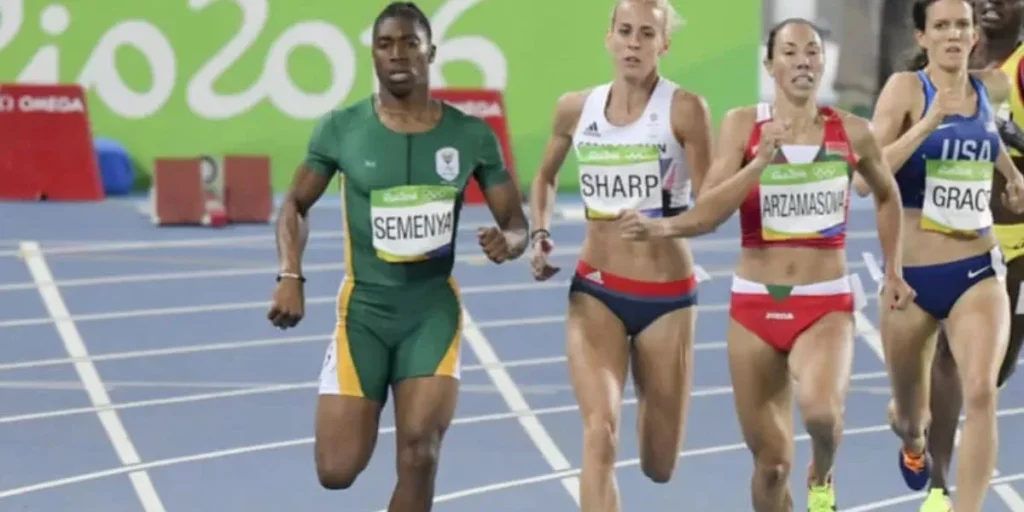
- Olympic Games: Gold Medal (800m) – London 2012, Rio 2016.
- World Championships: Gold Medal (800m) – Berlin 2009, Daegu 2011, London 2017; Bronze Medal (1500m) – London 2017.
- Commonwealth Games: Gold Medal (800m & 1500m) – Gold Coast 2018.
- National Honours: Order of Ikhamanga (Bronze) awarded by the South African government in 2014.
- Media: Named one of Time magazine’s 100 Most Influential People (2019).
Personal Life and Relationships
Caster Semenya is married to her long-term partner, Violet Raseboya. The couple first met in 2007 during a doping control session where Raseboya initially mistook Semenya for a boy. They began dating shortly after and held a traditional wedding ceremony in December 2015, followed by a high-profile civil ceremony in January 2017. Their relationship has been a pillar of support for Semenya throughout her public legal challenges.
Family life
Semenya remains deeply connected to her roots in Limpopo. She and Violet are parents to two daughters. Their first daughter, Oratile (born 2019), was conceived via artificial insemination after four unsuccessful attempts. Their second daughter was born in 2022. Semenya often shares that motherhood has “upgraded” her, shifting her focus from personal glory to securing a legacy for her children.
Associated with
- Nike: Her primary sponsor and vocal supporter during her eligibility battles.
- Glenrose Xaba: The South African distance runner whom Semenya currently coaches.
- Nelson Mandela: Semenya has frequently cited the late South African president as a primary inspiration for her resilience.
- World Athletics: The governing body with which she engaged in a decade-long legal dispute regarding DSD (Differences of Sexual Development) regulations.
Real Estate
- Limpopo Residence: In 2009, the Limpopo provincial government partnered with developers to build a home for Semenya’s family in recognition of her world title.
- Caster Semenya House: The Limpopo Olympic Towers in Polokwane were officially renamed “Caster Semenya House” in 2016.
- Private Property: She owns a modern private residence in the Gauteng province, where she resides with her wife and children.
Net Worth History
- 2009–2012: Rapid growth following her first World and Olympic titles; estimated at $500,000.
- 2016–2019: Peak earnings period with multiple Diamond League wins and major Nike renewals; estimated at $2 million.
- 2020–2024: Shift toward advocacy and legal battles; net worth stabilized through endorsements and the release of her memoir.
- 2025–2026: Reached an estimated $2.5M–$5M following the conclusion of her legal cases and expansion into coaching and global speaking.
Trivia
- She played professional soccer for the South African club JVW FC in 2019.
- Semenya was born with internal testes and no uterus, a condition known as 5-alpha reductase deficiency.
- She refuses to refer to herself as “intersex,” preferring the phrase “a different kind of woman.”
- In October 2025, her legal team officially ended her 7-year battle against World Athletics, citing her victory at the European Court of Human Rights as a “highly successful outcome.”
BIOGRAPHY
Executive Summary
Caster Semenya is a South African middle-distance runner whose career represents one of the most significant intersections of sport, science, and human rights in the 21st century. Emerging from rural Limpopo, she dominated the women’s 800m for over a decade, securing two Olympic gold medals and three World Championship titles. Her career, however, became a global flashpoint in 2009 when her biological sex was publicly questioned by track and field’s governing body, World Athletics.
For years, Semenya was at the center of a legal and ethical storm regarding Differences of Sexual Development (DSD). Forced to choose between taking hormone-suppressing medication or being barred from her signature events, she chose to fight. Her journey took her through the Court of Arbitration for Sport (CAS), the Swiss Federal Tribunal, and finally the European Court of Human Rights (ECHR). In July 2025, the ECHR Grand Chamber delivered a landmark ruling in her favor, finding that the Swiss courts had failed to protect her from discrimination. By October 2025, Semenya officially concluded her legal challenges, viewing the ECHR victory as a definitive vindication of her human dignity.
As of May 2026, Semenya has successfully transitioned from an active competitor to a mentor and advocate. She currently focuses on coaching the next generation of South African athletes and promoting her autobiography, The Race to Be Myself. Her legacy is no longer defined solely by her sub-1:55 times on the track, but by her unwavering refusal to alter her body to fit institutional definitions of womanhood. Today, she remains a global icon for intersex rights and a symbol of resilience, living in South Africa with her wife, Violet, and their two daughters.