How to Get Married Virtually: A Complete Guide to Online Wedding Ceremonies
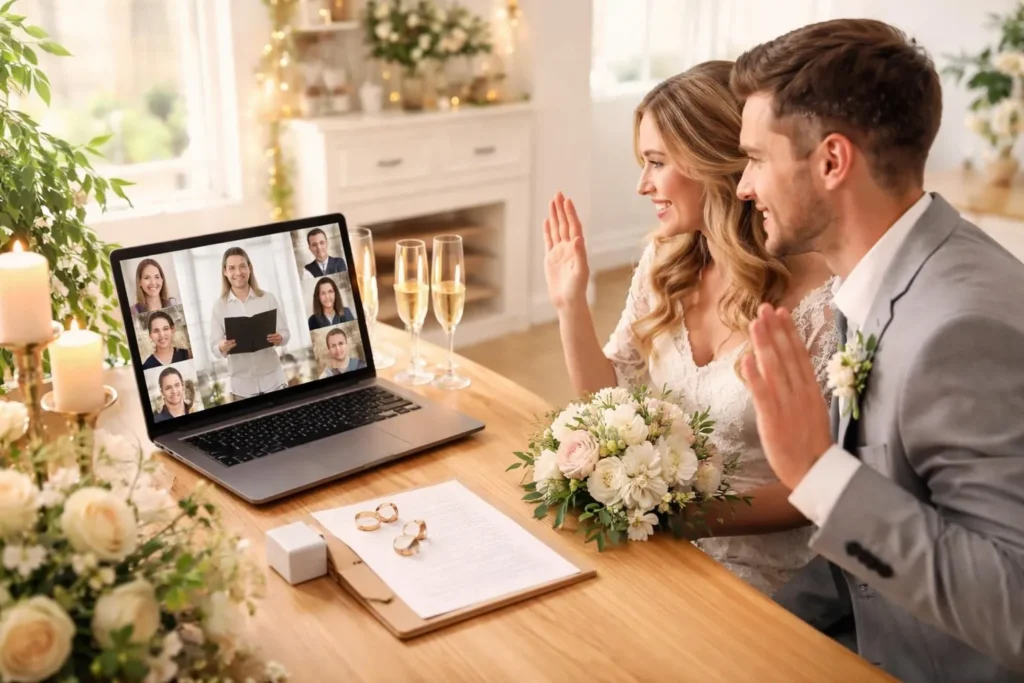
Knowing how to get married virtually has become essential for couples separated by distance, immigration restrictions, health challenges, or a genuine preference for an intimate digital ceremony. How to get married virtually involves two distinct components: the legal process of obtaining a marriage license and having your vows officiated in a way your state or country recognizes, and the practical planning of the online ceremony itself. The good news is that getting married virtually is entirely legal in a growing number of U.S. states and countries, and the process is more straightforward than most couples expect. Whether you are planning a fully remote wedding with guests joining by video, a courthouse-alternative online ceremony, or a proxy marriage across international borders, this complete guide to how to get married virtually covers every legal, logistical, and ceremonial step you need to make it real, official, and memorable.
What Is a Virtual Marriage and How Does It Work
A virtual marriage is a legally recognized or ceremonially performed wedding in which the couple, the officiant, or both participate remotely using video conferencing technology rather than being physically present in the same location.
Virtual marriages take several forms depending on the legal framework in your jurisdiction. In some U.S. states, couples can appear before an officiant via video call, exchange vows, and have the ceremony legally recognized without either party being physically present in the state. In others, at least one party must be physically present. Some countries allow fully remote proxy marriages where neither partner attends in person and a legal representative stands in.
The virtual marriage process generally involves three stages: obtaining a marriage license (which may or may not require in-person appearance depending on your location), conducting the ceremony via video platform with a legally authorized officiant, and filing the signed marriage certificate with the appropriate government office.
Is a Virtual Marriage Legal
The legality of a virtual marriage depends entirely on where you obtain your marriage license and where the ceremony takes place legally. This is the single most important thing to understand before making any plans.
In the United States, marriage law is governed at the state level. A small but growing number of states have passed legislation explicitly permitting remote or virtual marriage ceremonies. Understanding which states allow online weddings — and the specific requirements attached — is the critical first step.
Outside the United States, virtual and proxy marriages are recognized in various countries including Mexico, Japan, and parts of Europe, each with its own procedural requirements. If you are an international couple or planning a cross-border marriage, consulting with a legal professional familiar with both jurisdictions is strongly recommended.
The virtual ceremony itself — the video call with an officiant and guests — is distinct from the legal marriage. You can have a beautiful online ceremony that is ceremonially meaningful but legally separate, while completing the legal paperwork independently. Many couples choose this path for flexibility.
U.S. States That Allow Virtual and Online Marriages
The legal landscape for virtual marriages in the United States has expanded significantly since 2020. Here is the current landscape by category:
States with established remote marriage laws:
Utah was one of the first states to allow fully remote marriage ceremonies, permitting couples to obtain a marriage license online and complete the entire process without appearing in person. Couples from any state or country can use Utah’s remote marriage process.
Alaska permits remote notarization and has provisions that allow some elements of the marriage process to be completed online.
Colorado has a unique self-solemnization law that allows couples to marry without an officiant at all, and the license process can be largely completed remotely.
Virginia introduced remote solemnization laws that allow officiants to perform ceremonies via video conference when specific conditions are met.
States with emergency or temporary provisions: Several states enacted temporary virtual marriage allowances during the COVID-19 pandemic. Some of these provisions have been made permanent, while others have expired. Always verify the current status directly with your county clerk’s office before proceeding.
States where in-person appearance is still required: Many states still require at least one party — or both — to appear in person at a county clerk’s office to obtain a marriage license. In these states, the ceremony itself may be conducted virtually with a remote officiant, but the license procurement step requires physical presence.
How to Get Married Virtually Step by Step
This is the complete process for getting married virtually in a jurisdiction that permits it — using Utah’s remote marriage program as the most widely accessible example for U.S. and international couples.
Step 1: Determine Your Legal Jurisdiction
Decide where your marriage will be legally registered. If your home state does not allow virtual marriages, consider whether obtaining a license in a permissive state like Utah makes sense for your situation. A marriage legally performed in Utah is valid and recognized in all other U.S. states under the Full Faith and Credit Clause of the Constitution.
Step 2: Apply for Your Marriage License Online
In states with remote marriage programs, the license application is completed entirely online. You will provide both partners’ full legal names, dates of birth, identification document information, and current addresses. Some jurisdictions require a waiting period between application approval and ceremony — Utah, for example, has no waiting period for most applicants.
The fee for a marriage license varies by state and county, typically ranging from $25 to $100. Processing times vary — some online systems issue licenses within 24 hours, while others take several business days.
Step 3: Find a Legally Authorized Online Officiant
Your officiant must be legally authorized to perform marriages in the jurisdiction where your license is issued. For remote marriages, this means the officiant must be ordained or licensed in that state and authorized to perform remote ceremonies.
Several online platforms connect couples with officiants specifically experienced in virtual and remote marriage ceremonies. Many ordained ministers through organizations like the Universal Life Church are authorized to perform virtual ceremonies in permissive states. Always verify your officiant’s credentials against the specific requirements of your license-issuing jurisdiction before booking.
Step 4: Choose Your Video Platform
Any reliable video conferencing platform works for the ceremony itself. The most commonly used options are Zoom, Google Meet, Microsoft Teams, and FaceTime for smaller gatherings. Zoom is the most popular choice for virtual weddings because it allows large guest counts, recording, breakout rooms, and screen sharing for slideshows or music.
For the legally binding portion, your officiant and both partners must be visible on camera simultaneously. Most jurisdictions with remote marriage laws specify that the ceremony must be conducted in real time — pre-recorded ceremonies do not satisfy legal requirements.
Step 5: Conduct the Ceremony
On your ceremony date, both partners join the video call along with your officiant and any witnesses required by your jurisdiction. Most states require at least one witness; some require two. Witnesses can typically participate remotely in jurisdictions that allow virtual ceremonies.
The officiant will lead the ceremony, ask for your vows, and pronounce you married. The ceremony follows the same structure as an in-person wedding — opening remarks, vows, ring exchange if desired, pronouncement, and closing.
Step 6: Sign and File Your Marriage Certificate
After the ceremony, you and your officiant will need to sign the marriage certificate. In fully remote jurisdictions, this is handled via electronic signature platforms. The signed certificate is then filed with the county clerk’s office, either digitally or by mail depending on the jurisdiction.
Once filed and recorded, you will receive your official marriage certificate — the legal proof of your marriage — by mail or digital download depending on the county.
Best Platforms for Virtual Wedding Ceremonies
Choosing the right video platform shapes the entire experience for you and your guests. Here is how the major options compare for online wedding ceremonies.
| Platform | Max Free Guests | Recording | Best For |
|---|---|---|---|
| Zoom | 100 (free, 40-min limit) | Yes | Large virtual weddings, guest interaction |
| Google Meet | 100 | Yes (paid) | Simple, accessible, no app required |
| Microsoft Teams | 300 | Yes | Corporate-adjacent, formal ceremonies |
| FaceTime | 32 | No | Intimate, small family ceremonies |
| StreamYard | Unlimited viewers | Yes | Livestreamed ceremonies with large audiences |
| Vimeo Livestream | Unlimited viewers | Yes | High-production virtual weddings |
For most couples hosting a virtual wedding with up to 100 guests, Zoom with a paid account is the most practical and feature-rich choice. For very small ceremonies of ten people or fewer, Google Meet or FaceTime works beautifully without any subscription cost.
How to Plan a Virtual Wedding Ceremony
The legal process handles the official side — planning makes the ceremony meaningful. A virtual wedding can be just as personal, emotional, and beautiful as an in-person celebration when it is approached with intention.
Set a Clear Time That Works Across Time Zones
If your guests are joining from different parts of the world, choose a ceremony time that is reasonable across the major time zones represented. Clearly communicate the time in each relevant zone on your digital invitation.
Send Digital Invitations
Online invitations through platforms like Paperless Post, Zola, or The Knot allow you to include the video call link, RSVP tracking, and ceremony details in one place. Send invitations three to four weeks in advance for a virtual ceremony.
Create a Ceremony Backdrop or Setting
Your physical environment matters even through a screen. Choose a clean, meaningful, or decorated background. Many couples use a simple backdrop with flowers, string lights, or meaningful objects. Ring lighting or natural window light dramatically improves video quality.
Prepare a Ceremony Program to Share
Send guests a digital ceremony program in advance so they know the order of events, any participation moments, and relevant readings or music. This helps guests feel included rather than passive viewers.
Test Your Technology in Advance
Do a full technical rehearsal at least 48 hours before the ceremony. Test your camera, microphone, lighting, and internet connection. Have a backup device and a backup internet source — a mobile hotspot — ready in case of technical difficulties on the day.
Incorporate Guests Meaningfully
Virtual ceremonies can feel passive for guests unless you intentionally build in participation. Consider a moment where guests can unmute to cheer after the pronouncement, a pre-ceremony social time in the video call, a virtual toast, or a post-ceremony reception in smaller breakout rooms.
Hire a Virtual Wedding Planner or Coordinator
A growing number of wedding planners specialize in virtual and hybrid ceremonies. A coordinator managing the back end of your video call — admitting guests, managing muting, cueing music, and troubleshooting — allows you to be fully present in the moment rather than managing logistics.
Virtual Wedding vs In-Person Wedding: Key Differences
| Factor | Virtual Wedding | In-Person Wedding |
|---|---|---|
| Cost | Significantly lower (average $500–$3,000) | Higher (average $30,000+ in U.S.) |
| Guest access | Global, no travel required | Local or travel dependent |
| Legal process | Varies by state/country | Standardized in most jurisdictions |
| Intimacy | Smaller, more focused | Larger, more immersive |
| Flexibility | High — can be planned quickly | Lower — venues book months ahead |
| Photography | Screen recordings, digital photos | Full professional photography |
| Guest experience | Remote, screen-based | Physical, shared space |
International and Cross-Border Virtual Marriages
For couples in different countries, or couples where immigration or travel restrictions prevent a shared physical location, virtual and proxy marriages offer a legal path forward.
Proxy marriages allow one or both partners to be represented by a legal stand-in during the ceremony when they cannot be present. Several U.S. states — including Montana, Colorado, Texas, and California — allow proxy marriages under specific circumstances, often including military deployment or documented inability to appear.
International recognition of virtual marriages varies. A marriage legally performed under U.S. law in a state that permits remote ceremonies is generally recognized by U.S. federal agencies including USCIS (U.S. Citizenship and Immigration Services) for immigration purposes, provided the marriage meets the legal requirements of the state where it was performed.
Couples using a virtual or proxy marriage for immigration purposes should consult with an immigration attorney before proceeding to ensure their marriage will be recognized in the relevant legal contexts.
Cost of Getting Married Virtually
One of the most significant advantages of a virtual marriage is cost. The core legal and ceremonial expenses are minimal compared to a traditional wedding.
| Expense | Typical Cost |
|---|---|
| Marriage license | $25 – $100 |
| Online officiant | $50 – $300 |
| Video platform (paid) | $0 – $50/month |
| Digital invitations | $0 – $75 |
| Virtual ceremony backdrop/decor | $50 – $300 |
| Virtual wedding coordinator | $200 – $800 |
| Optional livestream production | $500 – $2,000 |
A fully legal virtual marriage can be completed for well under $500. A thoughtfully planned virtual wedding ceremony with professional elements typically runs between $500 and $3,000 — a fraction of the cost of a traditional wedding.
Conclusion
Understanding how to get married virtually opens up a path to legal, meaningful marriage that does not depend on geography, venue availability, or budget. The process is more accessible than most people expect — particularly through remote-friendly states like Utah — and the ceremony itself can be as personal, emotional, and beautiful as any traditional wedding. Whether you are bridging a physical distance, navigating immigration circumstances, planning a low-cost intimate celebration, or simply choosing a format that fits your life, a virtual marriage gives you the flexibility to make your commitment real on your own terms. Start with the legal requirements for your chosen jurisdiction, find a qualified online officiant, choose a reliable video platform, and build a ceremony that reflects who you are as a couple. The medium is digital — but the marriage is entirely real.
Frequently Asked Questions
Is getting married virtually legally binding?
Yes — a virtual marriage is legally binding when conducted in a jurisdiction that permits remote ceremonies, with a legally authorized officiant, and properly filed marriage certificate. The marriage is as legally valid as any in-person ceremony.
Which U.S. states allow fully remote online marriages?
Utah is the most widely accessible state for fully remote marriages and accepts applicants from any state or country. Colorado, Virginia, and Alaska also have provisions supporting remote or self-solemnized marriages, though specific requirements vary.
Can I get married virtually if I live in a state that does not allow it?
Yes — you can obtain a marriage license in a state that permits virtual marriages (such as Utah) regardless of where you live. The marriage will be legally valid and recognized in your home state.
Do both partners need to be in the same location for a virtual wedding?
No — in jurisdictions that fully permit remote ceremonies, both partners can be in completely different locations, even different countries, as long as they are both visible on video during the ceremony.
Can witnesses attend a virtual wedding remotely?
In most states that allow virtual marriages, witnesses can participate remotely via the same video call. Confirm the specific witness requirements with your county clerk or officiant before the ceremony.
How long does it take to get married virtually?
The timeline from application to legal marriage can be as short as one to three days in states with online license processing and no waiting period. Planning a virtual ceremony with guests typically takes two to four weeks.
Is a virtual marriage recognized for immigration purposes?
A virtual marriage legally performed under state law is generally recognized by USCIS for immigration purposes. Couples using virtual marriage for immigration-related reasons should consult an immigration attorney to confirm recognition in their specific circumstances.
What happens if the video call drops during a virtual ceremony?
Most officiants experienced in virtual ceremonies have a contingency plan — typically reconnecting via phone or a backup platform and continuing from where the ceremony left off. Confirm your officiant’s backup protocol before the ceremony date.
Can I have a virtual wedding and a physical celebration later?
Absolutely — many couples complete the legal virtual marriage first, then hold a larger in-person celebration later when timing, budget, or circumstances allow. The legal ceremony and the celebratory event are entirely separate, and many couples choose this approach intentionally.