
The 1999 teen romantic comedy 10 Things I Hate About You stands as a definitive pillar of the genre, notable for its sharp adaptation of Shakespeare’s The Taming of the Shrew and its enduring influence on millennial and Gen Z aesthetics. Among the film’s many visual hallmarks, none is more enduring than the prom dress worn by Kat Stratford, played by Julia Stiles. While the film is celebrated for its soundtrack and witty dialogue, Kat’s prom ensemble serves as a vital piece of character development, a subversion of 90s fashion tropes, and a masterclass in costume design. To understand the significance of this garment, one must look beyond the fabric and into the narrative weight it carries.
Defying the “Makeover” Trope
In the landscape of 1990s teen cinema, the “prom transformation” was a predictable narrative device. From She’s All That to Clueless, the protagonist typically undergoes a radical physical change to signify her readiness for social acceptance. However, Kat Stratford’s prom look is revolutionary because it is not a departure from her identity, but an elevation of it. Kat is established as a fiercely independent, feminist intellectual who disdains the performative nature of high school social hierarchies.
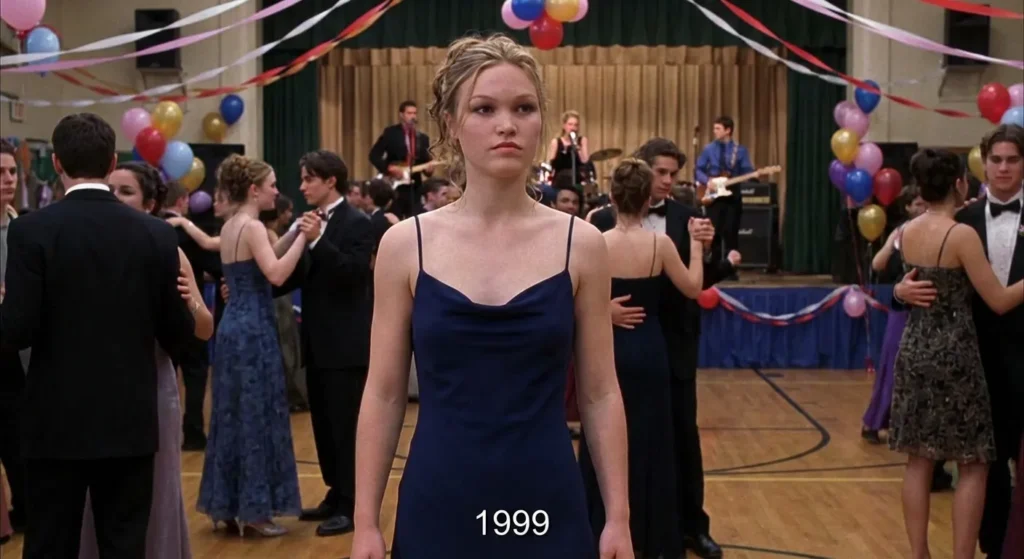
When she finally decides to attend the prom—largely out of a burgeoning, complicated affection for Patrick Verona—the dress she chooses reflects this internal consistency. It is not a dress designed to make her look like a “popular girl”; it is a dress that makes her look like a more refined, vulnerable version of the girl she has been throughout the entire film. The deep, moody iris-blue hue of the gown maintains her “outsider” edge while conceding to the formality of the event.
Design and Aesthetic Composition
The dress, designed by costume designer Kim Tillman, is a masterclass in “90s minimalism meets classicism.” It consists of two distinct pieces: a structured, spaghetti-strap corset bodice and a floor-length, bias-cut silk skirt. The choice of a two-piece silhouette was a subtle nod to the burgeoning trends of the late 90s, yet it avoided the gaudy sequins and neon palettes that characterized many actual prom trends of 1999.
The color is arguably the most striking feature. Often described as a periwinkle or deep lavender, the shade sits perfectly between “hard” and “soft.” It complements Julia Stiles’ cool skin tone and blonde hair, providing a visual “pop” against the dark, moody lighting of the prom venue. The neckline is a classic square cut, which emphasizes Kat’s posture and athletic frame, reinforcing her character’s strength even in a moment of romantic vulnerability.
The Subversion of Femininity
Kat Stratford spends much of the film criticizing the patriarchal expectations placed upon young women. Her daily wardrobe consists of oversized sweaters, cargo pants, and Birkenstocks—uniforms of 90s riot grrrl influence and intellectual indifference. For Kat to wear a dress is a significant narrative concession. However, the dress succeeds because it doesn’t feel like a costume.
The inclusion of the sheer black shawl draped over her shoulders is a crucial styling choice. It adds a layer of protection and modesty that aligns with Kat’s guarded personality. It also creates a “darker” aesthetic contrast to the lighter blue of the dress, ensuring she doesn’t appear too saccharine. This is further supported by her hair: a simple, slightly messy updo with loose tendrils. Unlike her sister Bianca, whose prom look is hyper-feminine, pink, and meticulously polished, Kat’s look feels effortless and slightly undone. It suggests that while she is participating in the ritual, she is doing so on her own terms.
Narrative Symbolism: The Turning Point
The prom sequence in 10 Things I Hate About You is the emotional climax of the film. It is where Kat allows herself to be seen, both literally and figuratively. The dress acts as a bridge between her cynical exterior and her sensitive interior. When she enters the prom and Patrick sees her for the first time, the dress facilitates a moment of genuine awe that isn’t based on a “shocking” transformation, but on the realization of her beauty and her willingness to meet him halfway.
The garment also plays a role in the subsequent heartbreak. When Kat discovers the bet involving Patrick, the dress becomes a symbol of her misplaced trust. The visual of Kat, elegant and exposed in her silk gown, fleeing the party highlights the sting of the betrayal. The dress, which represented her opening up to the world, becomes the outfit in which she is most publicly wounded. This juxtaposition is what makes the visual so memorable; the beauty of the attire heightens the tragedy of the scene.
The Legacy of the “Kat Stratford Dress”
Decades after the film’s release, the “Kat Stratford prom dress” remains a frequent reference point for fashion designers and prom-goers alike. It has achieved a “timeless” status that few other teen movie outfits manage. This is largely because the design avoided the “trend-traps” of the era. By leaning into a minimalist, slip-dress-adjacent aesthetic, the look has aged remarkably well.
In the contemporary era of “90s nostalgia,” the dress has seen a resurgence in popularity on platforms like Pinterest and TikTok. It represents an aspirational “cool-girl” aesthetic: one that is feminine but not fragile, stylish but not trendy. It serves as a reminder that the most iconic fashion moments in cinema are those that are deeply rooted in character. Kat Stratford didn’t just wear a blue dress; she wore a statement of her evolving identity, making it one of the most significant garments in the history of the teen film genre.