Steven Paul judd: Biography, Net Worth, Age, Personal Life & Career
The following is a comprehensive biographical report for steven paul judd, based on the most recent data as of May 12, 2026.
PROFILE DETAILS
NAME: Steven Paul Judd
REAL NAME: Steven Paul Judd
AGE: 54 years old (as of 2026)
Gender: Male
weight: Information not publicly available
Height: Information not publicly available
Birthdate: 1972 (Specific month/day not publicly confirmed)
Birth Sign: Information not publicly available
Birthplace: Lawton, Oklahoma, USA
NET WORTH: Estimated $2.5 Million – $5 Million
Salary: Information not publicly available (WGA standard rates for television writing)
MAIN INCOME SOURCE: Visual Art Sales, Television Writing, and Film Directing
Profession: Artist, Filmmaker, Screenwriter, and Author
RELIGION: Raised Methodist (Son of Methodist ministers)
FAMILY: Kiowa and Choctaw heritage
PARENTS: Information not publicly available (Both served as Methodist ministers)
SPOUSE: Information not publicly available
CHILDREN: Information not publicly available
CAREER: 2008–Present
Nationality: American (Kiowa/Choctaw)
SOCIAL PROFILES: Instagram (@stevenpauljudd), X (@stevenpauljudd), Website (stoodis.com)
What is steven paul judd Net Worth and salary?
As of 2026, Steven Paul Judd’s net worth is estimated to be between $2.5 million and $5 million. His wealth is diversified across several high-value streams:
- Television Writing & Production: As a member of the Writers Guild of America (WGA), Judd has earned significant income from staff writing and consulting roles on major productions including Disney’s Zeke and Luther, Reservation Dogs, and Rutherford Falls.
- Visual Art & Merchandising: Judd is a business partner in The NTVS, a premier Native American streetwear brand. His original paintings and limited-edition prints frequently sell for thousands of dollars in the contemporary art market.
- Film & Media Projects: Income from directing independent films and selling screenplays to major networks like HBO, Netflix, and Disney.
- Speaking & Workshops: Judd is a sought-after speaker at universities and museums, conducting workshops on stop-motion animation and Indigenous representation.
Early Life
Steven Paul Judd was born in Lawton, Oklahoma, and is of Kiowa and Choctaw descent. He spent his formative years between Oklahoma and Mississippi. His upbringing was deeply influenced by his parents’ roles as Methodist ministers. Notably, Judd suffered from polio as a young child, which required surgery on his leg to enable him to walk. Due to his grandfather’s strict religious beliefs, his family did not own a television for much of his early childhood, a factor he often cites as the reason for his intense fascination with pop culture once he was finally exposed to it.
Before fame
Before becoming a household name in the Indigenous art world, Judd worked in social services. His transition into the entertainment industry began in earnest in 2008 when he was selected for the prestigious Disney/ABC Writing Fellowship Program in Los Angeles. This opportunity moved him from Oklahoma to California and served as the catalyst for his career as a professional screenwriter.
Awards
- United States Artists (USA) Hatch Fellow in Media (2016)
- Emmy Nomination (2017, 2019) for his contributions to Native-themed media and writing.
- Tribeca All Access Grant recipient.
- Multiple “Best Film” awards at various American Indian Film Festivals for works like Ronnie BoDean.
Personal Life and Relationships
Steven Paul Judd is known for being intensely private regarding his personal relationships. While he frequently shares his art and professional milestones on social media, he rarely discusses his romantic life or marital status. He currently resides in Oklahoma City, choosing to stay close to his roots rather than remaining in the Hollywood hub.
Family life
Judd comes from a family with deep ties to the Kiowa and Choctaw nations. His parents were both Methodist ministers, which provided a unique cultural intersection of traditional Indigenous values and Christian ministry. He has mentioned having siblings, with whom he shared his first experiences of discovering “forbidden” pop culture like The Wizard of Oz and The Incredible Hulk.
Associated with
- Sterlin Harjo & Taika Waititi: Judd was a key creative contributor and writer for the critically acclaimed series Reservation Dogs.
- A Tribe Called Red (The Halluci Nation): He designed iconic cover art and merchandise for the electronic music group.
- Marvel Comics: He created the Indigenous superhero character “American Eagle” for Marvel Voices: Heritage #1.
Real Estate
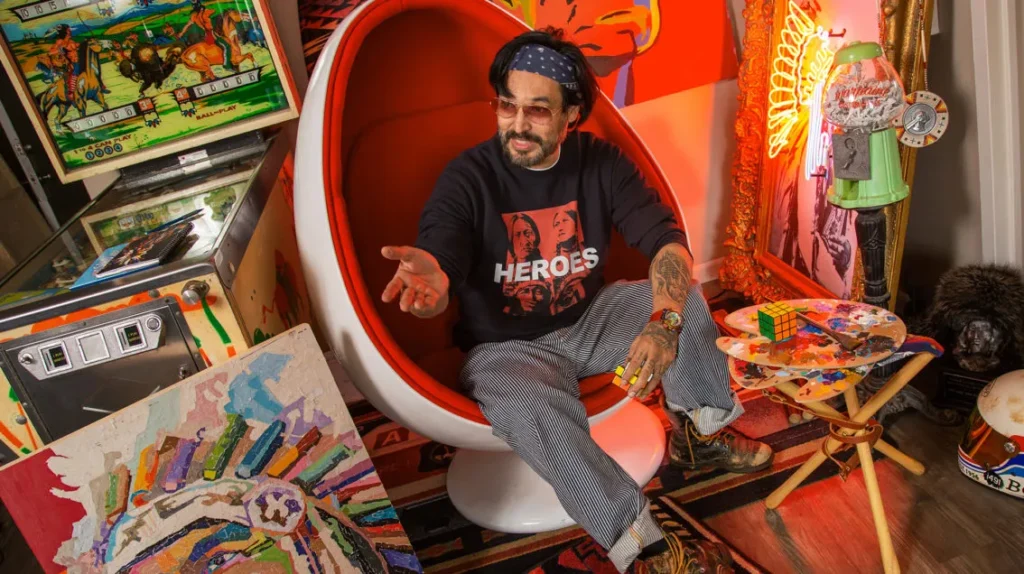
Judd maintains a residence and studio in Oklahoma City, Oklahoma. His home is often described as a “living gallery,” filled with his own pop-art creations, vintage toys, and Indigenous artifacts. While he has worked extensively in Los Angeles, he has publicly stated his preference for the Oklahoma art scene.
Net Worth History
- 2008–2012: $100K – $250K (Early writing career and fellowships)
- 2013–2018: $500K – $1M (Growth of The NTVS and independent film success)
- 2019–2023: $1.5M – $3M (Major TV contracts and high-profile art commissions)
- 2024–2026: $3M – $5M (Sustained success in streaming media and global art sales)
Trivia
- He is often referred to as the “Native Andy Warhol” or “Andy Warrior-hol” due to his pop-art style.
- Judd once gained viral fame for creating “toast art,” using a blowtorch to “paint” images of famous Native Americans onto slices of bread.
- He is an avid collector of Rubik’s Cubes and has used them to create large-scale mosaic portraits.
- His mural “War Paint” is a landmark feature in the historic “Indian Alley” in downtown Los Angeles.
BIOGRAPHY
Executive Summary
Steven Paul Judd is a visionary Kiowa/Choctaw artist, filmmaker, and writer who has become a central figure in the modern “Indigenous Futurism” movement. By the year 2026, Judd has solidified his legacy as a bridge-builder between traditional Native American culture and mainstream American pop culture. His work is characterized by a “Trojan Horse” approach—using humor and familiar pop-culture motifs (like Star Wars, Marvel, and 80s nostalgia) to deliver profound messages about decolonization, representation, and historical truth.
Judd’s career trajectory is a testament to the power of authentic storytelling. From his early days as a social worker to his breakthrough with the Disney/ABC Writing Fellowship, he has consistently prioritized the “Native gaze.” His involvement in the landmark series Reservation Dogs helped shift the paradigm of how Indigenous people are portrayed on screen, moving away from historical tropes toward contemporary, multi-dimensional narratives.
As a visual artist, Judd’s influence is pervasive. His partnership with The NTVS has revolutionized Native fashion, making Indigenous-designed streetwear a global commodity. His artwork is held in the permanent collections of major institutions, including the North Carolina Museum of Art and the Gorman Museum. Beyond his commercial success, Judd remains dedicated to mentorship, frequently traveling to tribal communities to teach stop-motion animation to Native youth. In 2026, he remains one of the most influential Indigenous creatives in the world, continuing to challenge stereotypes through the “war paint” of his ink and the weapon of his wit.