10 Traditional Wedding Vows: Timeless Examples, Meaning
Traditional wedding vows are the sacred words spoken between two people at the heart of every marriage ceremony. Whether you are planning a church wedding, a civil ceremony, or an interfaith celebration, traditional wedding vows carry a weight of meaning that modern couples continue to honor. These time-tested promises have united couples across centuries, cultures, and continents, and they remain the emotional cornerstone of the wedding ceremony. If you are searching for the right traditional wedding vows for your special day, this guide gives you 10 powerful examples, explains their origin and meaning, and shows you exactly how to make them your own without losing their timeless beauty.
What Are Traditional Wedding Vows?
Traditional wedding vows are formal promises exchanged between two people during a marriage ceremony, committing to love, honor, and support each other for life. Unlike modern personalized vows, traditional vows follow established wording rooted in religious texts, legal language, or cultural heritage. They typically include key pledges such as love in sickness and health, fidelity, and a lifelong commitment.
The structure of traditional vows has been refined over centuries to capture the full emotional and spiritual weight of marriage in just a few sentences. That is why so many couples, even today, return to these classic words when they want their ceremony to feel meaningful and grounded.
A Brief History of Traditional Wedding Vows
The history of traditional wedding vows stretches back to ancient Rome, where verbal pledges were part of the marriage contract. In the Christian tradition, the Book of Common Prayer introduced the vows most Western couples recognize today in 1549, including the famous phrase “to have and to hold, from this day forward.” These words were standardized by the Church of England and carried forward into Protestant, Catholic, and Anglican ceremonies across the world.
Jewish wedding vows, known as the Ketubah, date back even further, with the groom historically making promises of provision and honor to the bride. Hindu wedding vows involve the Saptapadi, or seven steps, taken around a sacred fire, each step representing a specific promise. Native American and Buddhist traditions also carry their own ancient forms of wedding pledges, reflecting the universal human need to mark marriage with spoken commitment.
Understanding this history helps couples appreciate why traditional wedding vows still hold such power. They connect your personal moment to something far larger than a single day.
10 Traditional Wedding Vows You Can Use
1. Classic Christian Vows (Book of Common Prayer)
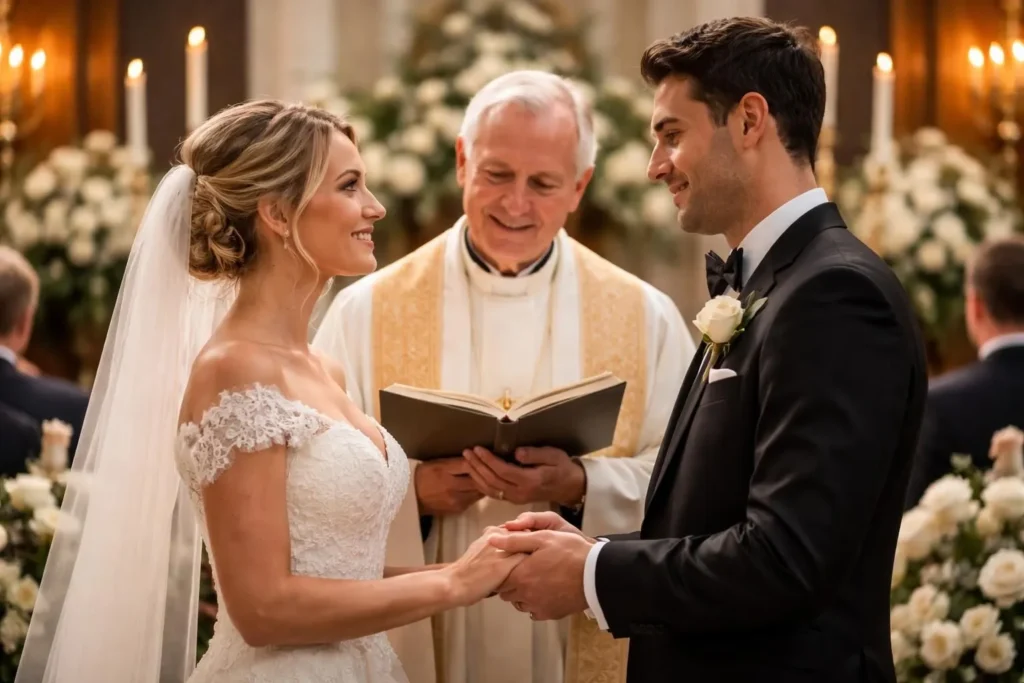
“I, [Name], take you, [Name], to be my wedded wife/husband, to have and to hold from this day forward, for better, for worse, for richer, for poorer, in sickness and in health, to love and to cherish, till death do us part, according to God’s holy ordinance, and thereto I pledge thee my faith.”
This is the most widely recognized form of traditional wedding vows in the English-speaking world. The phrase “to have and to hold” originally referred to both emotional companionship and the legal right of a husband to his wife’s property, though today it is understood as a promise of closeness and care.
2. Catholic Wedding Vows
“I, [Name], take you, [Name], to be my lawfully wedded wife/husband. I promise to be faithful to you, in good times and in bad, in sickness and in health, to love you and to honor you all the days of my life.”
Catholic wedding vows are slightly shorter and focus on faithfulness and honor. They are spoken during the Rite of Marriage and are considered a sacramental covenant recognized by the Catholic Church.
3. Methodist Wedding Vows
“I, [Name], take thee, [Name], to be my wedded wife/husband, to have and to hold from this day forward, for better, for worse, for richer, for poorer, in sickness and in health, to love and to cherish, until we are parted by death. This is my solemn vow.”
Methodist vows closely mirror the Book of Common Prayer but end with “This is my solemn vow,” reinforcing the gravity of the promise made before the congregation.
4. Baptist Wedding Vows
“I, [Name], take you, [Name], to be my wife/husband, and I promise and covenant before God and these witnesses to be your loving and faithful husband/wife, in plenty and in want, in joy and in sorrow, in sickness and in health, as long as we both shall live.”
Baptist vows emphasize the covenant nature of marriage and the presence of both God and the community as witnesses to the promises made.
5. Jewish Wedding Vows (Reformed Tradition)
“I, [Name], take you, [Name], to be my partner in life. I will cherish our friendship and love you today, tomorrow, and forever. I will trust and honor you. I will laugh with you and cry with you. I will love you faithfully through the best and the worst, through the difficult and the easy.”
In Reform Jewish ceremonies, couples often exchange mutual vows that emphasize partnership, friendship, and emotional equality alongside traditional religious commitment.
6. Civil or Non-Religious Wedding Vows
“I, [Name], take you, [Name], to be my partner, knowing in my heart that you will be my constant friend, my faithful partner in life, and my one true love. On this special day, I give to you in the presence of these witnesses my sacred promise to stay by your side as your partner in marriage.”
Civil wedding vows are legally binding promises designed for couples who want a secular ceremony. They can be used in courthouse weddings, destination ceremonies, or any non-religious setting, and they fulfill the legal requirements for marriage in most jurisdictions.
7. Scottish Traditional Wedding Vows
“I call upon these persons here present to witness that I, [Name], do take thee, [Name], to be my lawful wedded wife/husband, to have and to hold, from this day forward, for better for worse, for richer for poorer, in sickness and in health, to love and to cherish, till death us do part.”
Scottish traditional vows are often spoken in declaratory form, calling on witnesses to recognize the union. In Scotland, the legal wedding ceremony requires this declaratory and confirmatory wording, making it one of the most specific forms of traditional wedding vows by jurisdiction.
8. Hindu Wedding Vows (Saptapadi – Seven Steps)
The Saptapadi involves seven rounds around the sacred fire, each with a spoken pledge. The vows cover nourishment, strength, prosperity, happiness, children, health, and friendship. The seventh vow is: “With this seventh step taken together, you have become my most beloved friend. I will never cheat you. I will always love and respect you.”
Hindu wedding vows are among the most ancient traditional marriage promises in the world, and they cover every dimension of life that a couple will share together.
9. Episcopal Wedding Vows
“In the Name of God, I, [Name], take you, [Name], to be my wife/husband, to have and to hold from this day forward, for better for worse, for richer for poorer, in sickness and in health, to love and to cherish, until we are parted by death. This is my solemn vow.”
Episcopal vows open with the words “In the Name of God,” grounding the promise explicitly in faith. They are taken from the Book of Common Prayer and are nearly identical to Anglican vows used across the global Anglican Communion.
10. Quaker Wedding Vows
“In the presence of God and these our Friends, I, [Name], take thee, [Name], to be my wife/husband, promising with Divine assistance to be unto thee a loving and faithful husband/wife so long as we both shall live.”
Quaker vows are among the simplest and most intimate forms of traditional wedding vows. Because Quaker meetings have no clergy, the couple marries each other before their community, and all guests present sign the marriage certificate as witnesses.
The Meaning Behind the Most Famous Phrases
“For Better, For Worse”
This phrase acknowledges that marriage is a commitment made not just in good times but through every form of difficulty life may bring. It is perhaps the most honest line in any traditional wedding vow, recognizing that no life together is without hardship.
“In Sickness and in Health”
This promise specifically addresses the vulnerability of the human body and pledges care even when that care becomes demanding. For many couples, this is the most emotionally significant part of the traditional vow.
“To Love and to Cherish”
While “love” addresses the deep emotional bond, “cherish” takes things further. To cherish someone is to hold them in the highest regard, to protect and value them actively every day. This distinction makes traditional wedding vows richer than they might appear on first reading.
“Till Death Do Us Part”
This phrase sets the duration of the marriage promise as an entire lifetime. It is the clause that makes traditional wedding vows feel both weighty and beautiful, because it says that nothing short of death should end the commitment being made.
Traditional vs. Modern Wedding Vows: Key Differences
| Feature | Traditional Wedding Vows | Modern / Personalized Vows |
|---|---|---|
| Language style | Formal, archaic | Conversational, personal |
| Religious content | Often included | Optional |
| Length | Short and structured | Variable |
| Emotional tone | Solemn, reverent | Warm, sometimes humorous |
| Origin | Historical texts | Written by the couple |
| Flexibility | Fixed wording | Fully customizable |
| Legal standing | Recognized by law | May need legal supplement |
Most wedding officiants allow couples to choose between traditional and modern vows. Some couples use traditional vows as a base and add a personal line at the end, which gives them the best of both options.
How to Personalize Traditional Wedding Vows Without Losing Their Power
Personalizing traditional wedding vows does not have to mean abandoning their structure or meaning. The most effective approach is to keep the core promises intact while adding a sentence or two that reflects your unique relationship.
Start by choosing the traditional vow that best matches your ceremony style. Then identify one or two promises from that vow that resonate most deeply with you personally. Add a personal reflection before or after the standard text, such as referencing a specific memory, a shared value, or a quality you love in your partner.
Avoid making the personalized section too long. Traditional wedding vows carry their power partly through brevity. A short, heartfelt addition honors both the tradition and your individual story without turning the ceremony into a speech.
If you are having a religious ceremony, check with your officiant before making any changes. Some religious wedding vows must be spoken exactly as written to be considered valid within that faith tradition.
How to Memorize Your Wedding Vows
Memorizing traditional wedding vows is easier than memorizing personalized ones because the structure is already set, but wedding nerves can make even familiar words disappear in the moment. Practice your vows daily in the two weeks before your wedding, ideally out loud and in front of a mirror.
Record yourself saying the vows and listen back to catch any words you stumble over. Practice with your partner if you want the experience of hearing them respond in kind. On the day itself, it is always appropriate to have your vows written on a card held by your maid of honor or best man, or given to the officiant, just in case.
What to Expect During the Vow Exchange at Your Ceremony
The vow exchange typically happens after the processional and any readings or prayers selected for the ceremony. The officiant will prompt each partner to speak their vows, either repeating them phrase by phrase after the officiant or speaking them directly from memory or a card.
In most Western ceremonies, the person who proposed speaks their vows first, though this is not a rule. After both partners have spoken their traditional wedding vows, the officiant usually moves directly into the ring exchange, which is the physical symbol of the promises just made.
Traditional Wedding Vow Renewal: Reaffirming Your Commitment
Vow renewals are a beautiful way for long-married couples to revisit and reaffirm their traditional wedding vows. Many couples choose a significant anniversary such as 10, 25, or 50 years for their vow renewal ceremony. Unlike the original wedding, a vow renewal carries no legal requirement, which gives couples complete freedom to use their original vows, update them, or write something entirely new.
Vow renewals can be as simple as a private moment between two people or as elaborate as a second full wedding ceremony with family and friends. Some couples travel to a meaningful location to renew their vows, while others hold the renewal at the same venue where they were first married.
Frequently Asked Questions
What are the most common traditional wedding vows?
The most widely used traditional wedding vows come from the Book of Common Prayer and include the phrases “to have and to hold,” “for better or for worse,” “in sickness and in health,” and “till death do us part.” Catholic, Anglican, Methodist, and Episcopal ceremonies all use variations of this same core structure.
Can I change traditional wedding vows?
Yes, in most non-religious ceremonies you can modify traditional wedding vows as you wish. In Catholic, Orthodox, and some other religious ceremonies, the vows must follow the approved wording of that faith. Always confirm with your officiant before making any changes to religiously specific vows.
Do traditional wedding vows have to be religious?
No, traditional wedding vows do not need to be religious. Civil wedding vows are a secular form of traditional marriage promises that fulfill all legal requirements without any religious language. Many non-religious couples choose civil vows for their simplicity and legal clarity.
How long are traditional wedding vows?
Traditional wedding vows are typically spoken in under one minute. The classic Christian form contains approximately 60 to 80 words, which takes roughly 30 to 40 seconds to recite. This brevity is intentional and contributes to the emotional power of the words.
What is the difference between wedding vows and a wedding ring exchange?
Wedding vows are the spoken promises exchanged between partners, while the ring exchange is the physical act that follows, symbolizing those promises with a tangible object. The rings are considered a visible sign of the invisible commitment made through the vows.
Are traditional wedding vows legally binding?
In most countries, the specific words of the vows themselves are not what make a marriage legal. Legal recognition comes from the marriage license, the presence of an authorized officiant, and the required number of witnesses. However, the vow exchange is the ceremonial moment that gives the marriage its meaning.
What should I do if I cry during my vows?
Take a breath and pause for a moment. Wedding ceremonies are emotional events and officiants, guests, and partners all expect tears. If you are worried about this, practice speaking the words when you are already in an emotional state so that you build some familiarity with delivering them through strong feelings.
Conclusion
Traditional wedding vows are far more than a formality. They are the spoken architecture of a lifelong commitment, refined over centuries to capture in just a few sentences everything that marriage truly means. Whether you choose classic Christian vows, civil wedding vows, Hindu Saptapadi vows, or Quaker simplicity, each form of traditional wedding vow carries the same essential promise: to choose this person, fully and faithfully, for the rest of your life. The 10 examples in this guide give you a strong foundation to find or build the vows that will make your ceremony unforgettable. Read them slowly, consider their meaning carefully, and speak them with everything you have.