Factoring Calculator: Factor Any Number or Algebraic Expression Step by Step
A factoring calculator breaks down a number or an algebraic expression into its simplest multiplying parts, instantly and for free. Whether you need to find the factors of a whole number like 122 or factor a quadratic expression like x² + 5x + 6, a good factor calculator gives you the complete answer along with the working steps, so you actually understand how the result was reached instead of just copying a number.
In this guide, you’ll learn what a factoring calculator does, how to use one for both numbers and algebra, and how to read every part of the result, from prime factors to discriminants and roots.
What Is a Factoring Calculator?
A factoring calculator is an online tool that takes a number or an expression and rewrites it as a product of smaller factors. For numbers, that means listing everything that divides evenly into the number, pairing those divisors, and breaking the number down into its prime building blocks. For algebra, it means rewriting an expression like x² + 5x + 6 into a multiplied form like (x + 2)(x + 3), which makes solving equations and graphing functions far easier.
Doing this by hand works fine for small numbers and simple quadratics, but it gets slow and error-prone once numbers get larger or expressions involve negative coefficients, fractions, or non-integer roots. A calculator removes that friction while still showing every step, which is useful for checking homework, studying for exams, or just speeding up everyday math.
How to Use the Factor Calculator for Numbers
Factoring a whole number takes three steps on the Factor Calculator home page.
- Go to the home page at https://factor-calculator.com/.
- Type the number you want to factor into the input box.
- Tap Calculate.
The tool then returns a full breakdown of that number, completely free, with no sign-up required.
What You Get in the Results
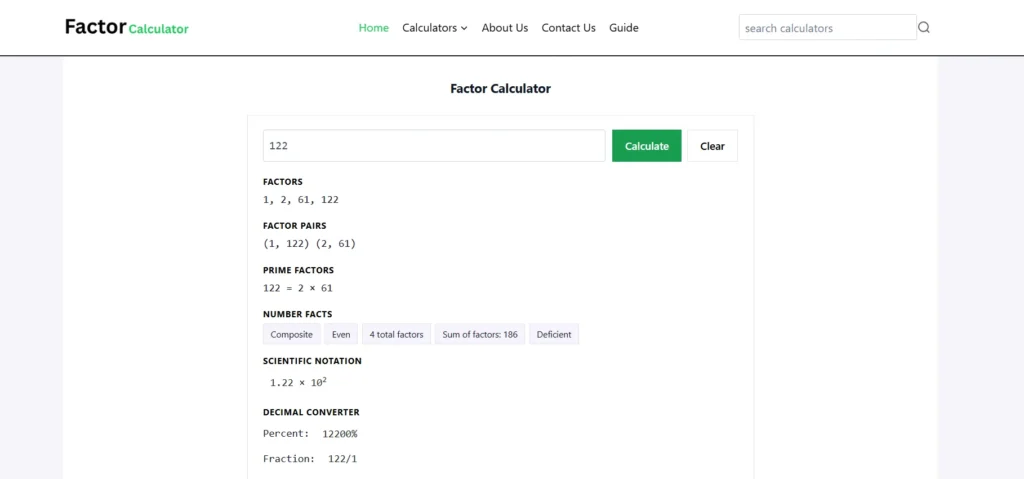
Entering a number like 122 returns several useful sections at once:
Factors – every whole number that divides evenly into your number. For 122, that’s 1, 2, 61, and 122.
Factor pairs – the factors grouped into multiplication pairs that equal the original number, such as (1, 122) and (2, 61).
Prime factors – the number broken down into only prime numbers, shown as a multiplication, for example 122 = 2 × 61.
Number facts – quick descriptors like whether the number is composite or prime, even or odd, how many total factors it has, the sum of its factors, and whether it’s deficient, perfect, or abundant.
Scientific notation – the number rewritten in scientific form, such as 1.22 × 10².
Decimal converter – the same value expressed as a percent and as a fraction, for example 12200% and 122/1.
This makes the calculator useful for more than just basic factoring. It doubles as a quick reference for prime factorization, number theory facts, and unit conversions, all from a single input.
How to Factor Algebraic Expressions Step by Step
For quadratic or linear expressions, use the dedicated Factoring Calculator tool.
- Open https://factor-calculator.com/factoring-calculator/.
- Enter a quadratic or linear expression in x, for example x^2+5x+6.
- Tap Factor.
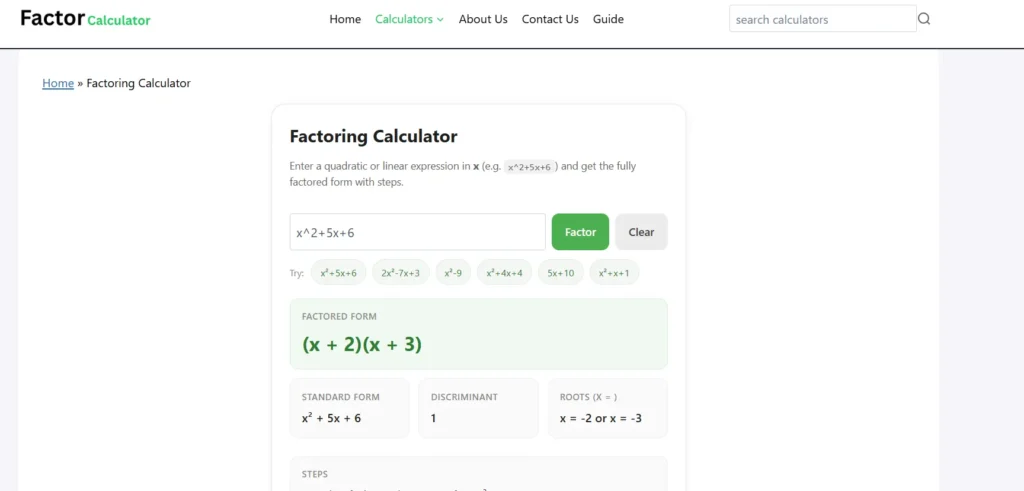
You’ll instantly see the fully factored form along with the standard form, the discriminant, the roots, and a complete step-by-step breakdown.
Worked Example: x² + 5x + 6
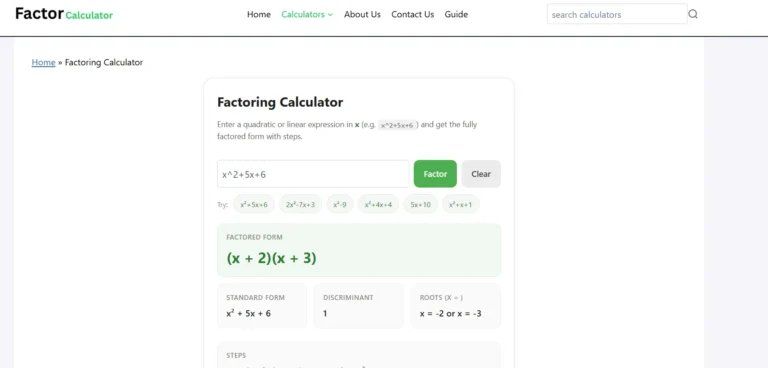
Here’s what the calculator shows for the expression x^2+5x+6:
Factored form: (x + 2)(x + 3)
Standard form: x² + 5x + 6
Discriminant: 1
Roots: x = -2 or x = -3
Behind the scenes, the calculator is solving this the same way you would on paper. It identifies the coefficients (a = 1, b = 5, c = 6), looks for two numbers that multiply to give c and add to give b (in this case 2 and 3), and uses those numbers to split the middle term and factor by grouping. The discriminant (b² – 4ac) confirms whether the roots are real and rational, which is why it shows up alongside the final answer.
If you’re not sure where to start, the calculator includes ready-made examples you can try with one tap, including x²+5x+6, 2x²-7x+3, x²-9, x²+4x+4, 5x+10, and x²+x+1. These cover the most common patterns: simple trinomials, expressions with a leading coefficient, difference of squares, perfect square trinomials, and linear binomials.
Why Use an Online Factoring Calculator
A few reasons this is worth using over manual factoring, especially for students and anyone brushing up on algebra:
It’s completely free, with no account or download needed. It shows full step-by-step working, not just the final answer, so you can learn the method instead of just getting a result. It handles both whole numbers and algebraic expressions in one place. It catches errors that are easy to make by hand, like sign mistakes when splitting middle terms or missing a factor pair. And it instantly surfaces extra detail, like discriminants, roots, and number facts, that you’d otherwise have to calculate separately.
Common Mistakes When Factoring by Hand
A few errors come up again and again when factoring manually. Forgetting to check for a greatest common factor first is one of the most common; always pull out any shared factor across all terms before attempting to factor a trinomial. Sign errors are another frequent issue, especially when the constant term is negative, since that means the two numbers you’re looking for must have opposite signs. Stopping too early is also common, particularly with numbers like 122, where it’s easy to find 1, 2, 61, 122 but forget to verify there are no other factors in between. Running your expression or number through a calculator is a fast way to confirm your manual work is correct before moving on.
Frequently Asked Questions
What is a factoring calculator used for?
A factoring calculator is used to break down numbers into their divisors and prime factors, and to rewrite algebraic expressions like quadratics into a multiplied, factored form. It’s commonly used by students checking homework, teachers preparing examples, and anyone who needs a quick, accurate factorization without doing the arithmetic by hand.
Is the factor calculator free to use?
Yes. The factor calculator at factor-calculator.com is completely free, requires no sign-up, and gives unlimited results with step-by-step explanations for both numbers and algebraic expressions.
Can this calculator factor quadratic equations?
Yes. The dedicated factoring calculator tool accepts quadratic expressions in the form ax² + bx + c, as well as simple linear expressions, and returns the fully factored form along with the standard form, discriminant, and roots.
How do I find the prime factors of a number?
Enter the number on the calculator’s home page and tap Calculate. The results include a Prime Factors section that shows the number broken down into only prime numbers, written as a multiplication, such as 122 = 2 × 61.
What does the discriminant tell you when factoring?
The discriminant, calculated as b² – 4ac, tells you what kind of roots a quadratic expression has. A positive discriminant means two distinct real roots, zero means one repeated real root, and a negative discriminant means the roots are complex rather than real numbers.
Does the calculator show the steps, or just the answer?
The calculator shows both. Along with the factored form, it displays a full steps section that walks through how the answer was reached, which makes it useful for learning the method rather than just getting a number to copy.
Final Word
Factoring by hand is a useful skill, but it’s slow and easy to get wrong once numbers or expressions get more complex. The factor calculator at factor-calculator.com handles both number factoring and algebraic factoring in one place, shows complete step-by-step working, and is free to use with no limits. Whether you’re checking a homework answer or factoring a quadratic for an exam, entering your number or expression and tapping Calculate gives you a verified result in seconds.