
Multiplier Explained: What It Is, How It Works, and Why It Matters
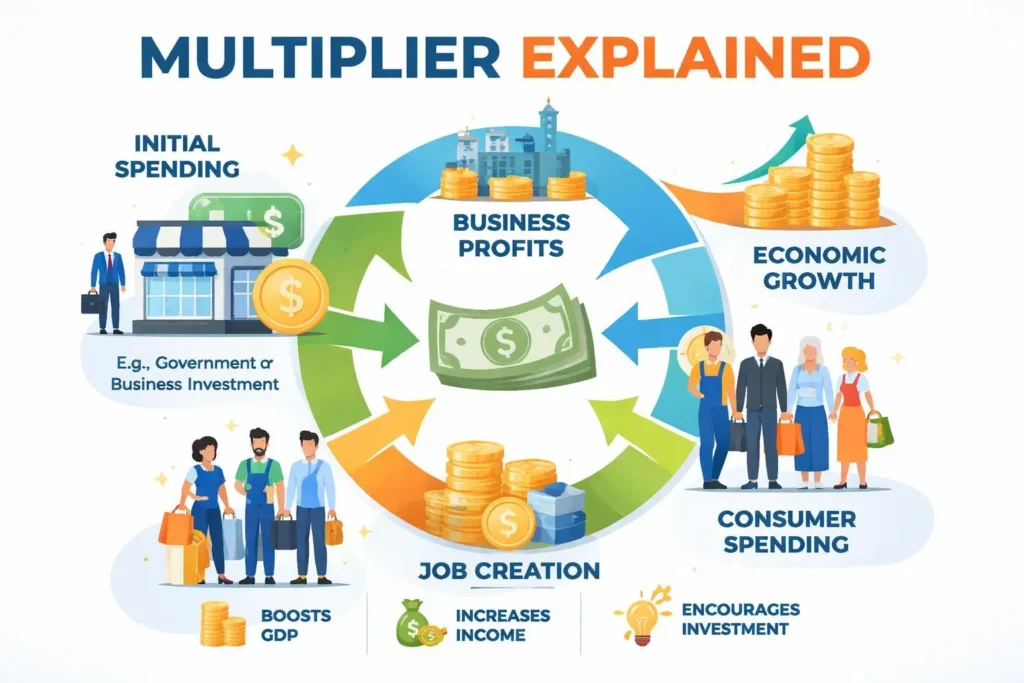
If you have ever wondered why a single government investment can ripple through an entire economy, or why one sale in a business creates revenue far beyond its face value, the answer lies in one concept: the multiplier. Understanding the multiplier is not just academic — it shapes government budgets, investment strategies, business decisions, and your personal financial planning.
This guide breaks down everything you need to know about the multiplier — what it means, how it works across different domains, and how you can apply the concept to make better decisions in real life.
What Is a Multiplier? A Clear and Simple Definition
A multiplier is a factor that amplifies an initial input to produce a larger final output. In its simplest form, it is a number that shows how much a change in one variable causes a proportionally larger change in another.
Think of it this way: if you drop a stone into a pond, the ripple spreads far beyond the point of impact. The multiplier is the measure of how wide those ripples travel.
In economics, the multiplier describes how an initial change in spending — by a government, a business, or a consumer — triggers a chain reaction of additional spending throughout the economy. In finance, it tells investors how much market value a company generates for every dollar of earnings. In business, it measures how efficiently inputs translate into outputs.
The concept is universal, and its applications are more relevant today than ever.
The Economic Multiplier Effect: How Money Moves Through an Economy
The economic multiplier effect is one of the most important ideas in macroeconomics. It explains why economic stimulus works — and why it sometimes fails.
How the Multiplier Effect Works Step by Step
When a government spends money — say, building a new highway — it pays construction workers. Those workers then spend their wages at local restaurants, shops, and service providers. Those businesses then pay their employees, who spend again, and the cycle continues.
The total economic activity generated is significantly larger than the original government expenditure. That amplification is the multiplier effect in action.
The size of the effect depends on one key variable: the marginal propensity to consume (MPC), which is the fraction of each additional dollar of income that people spend rather than save.
The formula for the basic fiscal multiplier is:
Multiplier = 1 ÷ (1 − MPC)
If the MPC is 0.8 (meaning people spend 80 cents of every extra dollar they earn), the multiplier equals 5. That means every $1 of government spending could theoretically generate $5 in total economic output.
Why the Multiplier Effect Is Not Always Perfectly Linear
In practice, the real-world multiplier is usually smaller than the theoretical maximum. Several factors reduce its size:
Taxes reduce the amount of each dollar that flows back into the economy. Imports divert spending outside the domestic economy. Savings rates vary across income groups and economic conditions. Confidence levels affect whether people actually choose to spend.
Understanding these limitations is just as important as understanding the concept itself. Policymakers who expect a multiplier of 5 but see a multiplier of 1.5 may need to recalibrate their assumptions.
Types of Multipliers You Need to Know
The multiplier is not a single concept — it appears in many different forms across economics, finance, and business. Each type serves a specific analytical purpose.
The Fiscal Multiplier
The fiscal multiplier measures the impact of government spending or tax changes on national income. A fiscal multiplier greater than 1 means that $1 of government spending produces more than $1 of GDP growth. A multiplier less than 1 means the stimulus has limited effect.
During recessions, fiscal multipliers tend to be higher because idle resources (unemployed workers, unused factory capacity) are available to absorb the new demand. During periods of full employment, the multiplier shrinks because new spending mainly drives inflation rather than real output growth.
The Money Multiplier
The money multiplier describes how banks expand the money supply beyond the initial deposits they receive. It is defined by the reserve requirement — the fraction of deposits banks must hold in reserve.
If the reserve requirement is 10%, a $1,000 deposit can theoretically generate up to $10,000 in total money supply through repeated lending and redepositing cycles.
Money Multiplier = 1 ÷ Reserve Requirement
Central banks use this mechanism to control the money supply through interest rates and reserve policies — making the money multiplier a foundational tool of monetary policy.
The Investment Multiplier (Keynesian Multiplier)
Named after economist John Maynard Keynes, the investment multiplier specifically measures how changes in private investment spending ripple through aggregate demand. Keynes argued that economies in recession could be revived by increasing investment — either private or public — because of this amplification effect.
This is the intellectual foundation behind modern stimulus programs used during the 2008 financial crisis and the COVID-19 pandemic.
The Equity Multiplier in Finance
In corporate finance and investment analysis, the equity multiplier measures financial leverage. It is calculated as:
Equity Multiplier = Total Assets ÷ Total Shareholders’ Equity
A higher equity multiplier means a company is using more debt to finance its assets. This can amplify returns when times are good — and amplify losses when conditions deteriorate. Investors use this metric to assess a company’s risk profile as part of the DuPont analysis framework.
The Price-to-Earnings (P/E) Ratio as a Market Multiplier
The P/E ratio is one of the most widely used valuation multipliers in stock market investing. It tells investors how much they are paying for each dollar of a company’s earnings.
A P/E of 20 means investors pay $20 for every $1 of annual earnings. A high P/E suggests the market expects strong future growth. A low P/E may signal undervaluation — or declining prospects.
Other valuation multipliers include price-to-book (P/B), enterprise value-to-EBITDA (EV/EBITDA), and price-to-sales (P/S). Together, these multipliers form the toolkit of fundamental equity analysis.
The Employment Multiplier
The employment multiplier estimates how many total jobs are created or supported for every direct job added in a particular sector. Industries with strong supply chains and high local spending — such as manufacturing and construction — tend to have high employment multipliers. Service industries with fewer upstream linkages typically have lower ones.
This metric matters deeply for economic development policy, helping governments identify which investments generate the greatest job creation.
Multipliers in Business: Operational and Revenue Leverage
Beyond macroeconomics and finance, multipliers are embedded in the logic of how businesses operate and grow.
Revenue Multipliers and Business Valuation
When a business is bought or sold, buyers and sellers often rely on revenue or EBITDA multipliers to determine a fair price. A company might be valued at 3x revenue or 10x EBITDA, depending on its industry, growth rate, and profitability.
These multipliers reflect market sentiment about future earnings power. A high revenue multiplier signals strong investor confidence. A low multiplier may reflect risk, saturation, or competitive pressure.
Understanding the multiplier your industry trades at is essential for founders, investors, and executives making strategic decisions.
The Operational Multiplier: Efficiency and Leverage
In operations management, the multiplier concept appears as operational leverage — the extent to which fixed costs amplify profit swings as revenue changes. A business with high fixed costs and low variable costs has high operational leverage, meaning that a modest increase in sales can produce a dramatic increase in profit.
This is why software companies — which have near-zero marginal cost per additional user — often achieve extraordinary profit expansion as they scale. Their operating multiplier is extremely high.
Real-World Applications of the Multiplier
Knowing what a multiplier is matters far less than knowing how to apply it.
For Investors
Valuation multipliers help investors determine whether a stock is cheap or expensive relative to peers. An investor comparing two companies in the same sector would prefer the one trading at a lower EV/EBITDA multiple if all other factors are equal — all else being equal, lower multiples offer more value.
However, blind reliance on multipliers without understanding the underlying business can lead to value traps — stocks that appear cheap but remain cheap for good reasons.
For Policymakers
Fiscal multipliers guide decisions about stimulus size and composition. Research consistently shows that spending multipliers differ significantly based on economic conditions, the type of spending (infrastructure vs. transfers), and whether monetary policy is accommodative.
During the 2020 COVID-19 stimulus programs in the United States, economists actively debated the size of multipliers to calibrate the $1.9 trillion American Rescue Plan appropriately.
For Business Leaders
Leaders who understand the multiplier can identify where in their business each dollar of investment generates the most return. Investing in a high-multiplier activity — such as training a sales team, improving customer retention, or automating a key process — can produce outsized returns compared to low-multiplier spending.
For Personal Finance
Even individuals benefit from multiplier thinking. Debt has a negative multiplier effect on wealth — interest compounds and grows the burden over time. Investments, by contrast, have a positive multiplier effect — compounding returns generate wealth far beyond the initial capital.
The earlier you invest, the more time compounding (the personal multiplier) has to work in your favor.
Common Misconceptions About Multipliers
Several widespread misunderstandings can distort how people interpret and apply multipliers.
One frequent error is assuming that all multipliers are greater than one. In some conditions — particularly open economies with high import dependence — the fiscal multiplier can be less than one, meaning government spending has a net contracting effect once the financing costs are accounted for.
Another misconception is treating multipliers as fixed constants. In reality, they change based on economic conditions, policy design, behavioral responses, and institutional context. A multiplier estimated in one decade or country may not apply in another.
Finally, many investors confuse a high valuation multiplier with quality. High multiples reflect optimism, not certainty. Overpaying based on inflated multiples has destroyed enormous amounts of investor wealth across every market cycle.
How to Calculate and Use Multipliers in Practice
Calculating multipliers depends on the specific type and context. Here are the key formulas organized for practical use:
The Keynesian fiscal multiplier: divide 1 by the quantity of (1 minus the marginal propensity to consume). The money multiplier: divide 1 by the reserve requirement ratio. The equity multiplier: divide total assets by total shareholders’ equity. The P/E ratio: divide the share price by earnings per share. The employment multiplier: divide total employment (direct plus indirect plus induced) by direct employment.
When applying any multiplier, always verify the assumptions behind it. Check whether the conditions under which it was calculated still apply. Adjust for context — a multiplier derived from US data may not transfer cleanly to a developing economy or a different industry.
The Multiplier in the Modern Economy: New Relevance for a Complex World
The multiplier concept has taken on new dimensions in the digital economy. Network effects — where each additional user of a platform increases the value for all other users — function as a form of demand-side multiplier. Companies like social media platforms, payment networks, and marketplaces derive much of their value from this mechanism.
Technology investment itself has a high multiplier: research consistently finds that investment in digital infrastructure, broadband, and productivity tools generates above-average returns for both private investors and national economies.
Climate policy is another domain where multiplier analysis is increasingly prominent. Green infrastructure spending is estimated to carry higher fiscal multipliers than fossil fuel subsidies, because clean energy projects create more domestic jobs per dollar spent and have lower import leakage.
Conclusion: Why Mastering the Multiplier Changes How You See the World
The multiplier is not just a formula — it is a lens for understanding how value propagates through systems. Whether you are evaluating a government budget, choosing a stock, structuring a business investment, or planning your personal savings strategy, multiplier thinking helps you see beyond the immediate impact of a decision to its full downstream effect.
The most financially sophisticated investors, the most effective policymakers, and the most strategic business leaders all share one habit: they think in multipliers. They ask not just what a decision costs or earns today, but how that initial input will echo through time, through supply chains, through markets, and through behavior.
Developing that habit is one of the highest-return investments you can make in your own thinking.